

Prediction Markets Are Creating a New Risk for Pharmaceutical Vendor Contracts
Prediction markets tied to clinical trials, regulatory decisions, and other pharmaceutical events are creating new questions for vendor contracts and confidentiality provisions. This article looks at what pharmaceutical and life sciences companies may want to review in their agreements and compliance policies.
Prediction markets are creating a new compliance issue for pharmaceutical companies.
Platforms now allow users to trade on events such as regulatory decisions, clinical trial outcomes, and other company specific developments. That creates a simple problem: people outside the company may have access to sensitive information before the market does.
In pharma, that can include CROs, laboratories, consultants, data vendors, clinical partners, and other service providers.
The risk is not limited to disclosure. Someone could use nonpublic information to place a position on an event tied to a clinical trial, FDA decision, regulatory milestone, or commercial development without ever sharing the information with anyone else.
That means companies should review whether their contracts restrict not only disclosure, but also the use of confidential information for prediction markets, event contracts, wagering, or similar financial activity.
What companies should review
Pharmaceutical and life sciences companies may want to look at:
confidentiality provisions
vendor agreements
consulting agreements
clinical services contracts
internal compliance policies
reporting and investigation rights
termination rights tied to misuse of information
The issue is straightforward. Contracts written years ago may not address the ways confidential information can be monetized today.
Clinical and regulatory information can have significant value before it becomes public. As prediction markets grow, legal and compliance teams should make sure their agreements reflect that reality.
Lanton, Lanton & Sosa Law PLLC advises pharmaceutical, healthcare, and life sciences companies on contracts, regulatory issues, vendor relationships, compliance, and commercial risk.
For a deeper discussion, see the recent PharmExec article:
Prediction Markets Expose a Gap in Pharmaceutical Vendor Contracts
https://www.pharmexec.com/view/prediction-markets-expose-gap-pharmaceutical-vendor-contracts

New Hire, New Deadlines: Six Employee-Notice Triggers Employers Should Track
Employee onboarding involves more than completing paperwork on the first day. Federal employment laws impose notice and compliance obligations at different stages, from hiring and employment verification to benefits enrollment and protected leave. Lanton, Lanton & Sosa Law examines six key compliance triggers employers and HR professionals should understand to help avoid missed deadlines and reduce workplace risk.
Hiring paperwork is more than payroll forms and policy acknowledgments. Federal notice obligations arise at different stages of employment, and treating them all as “first-day paperwork” can result in missed deadlines.
Here are six key compliance triggers:
When an employee is hired
Employers subject to the Fair Labor Standards Act must provide a written Health Insurance Marketplace notice at the time of hiring.
During employment-eligibility verification
Employers must complete the required verification process while allowing employees to choose which acceptable documents to present. Do not demand extra or different documents when the documents provided are sufficient and reasonably appear genuine.
When a covered federal contractor hires or assigns an employee
Federal contractors subject to the applicable E-Verify clause generally must initiate verification for covered new hires within three business days after hire. Different timing may apply to newly enrolled contractors and certain employees assigned to covered contracts.
When group health coverage begins
If federal COBRA or comparable public-sector continuation requirements apply, the plan must provide an initial notice to the covered employee and spouse, if any, when coverage begins. This may occur after the employee’s first day.
While the workplace operates
Required federal workplace notices must remain current, visible, and unobstructed. Depending on coverage, these may include wage-and-hour, workplace-safety, family-and-medical-leave, equal-employment-opportunity, and military-service rights notices. Providing copies during onboarding does not necessarily replace workplace posting.
When protected leave or a loss of health coverage occurs
Event-specific deadlines may apply. Potentially qualifying leave can trigger individualized Family and Medical Leave Act notices. A COBRA qualifying event can trigger deadlines for notifying the plan administrator and qualified beneficiaries.
Practical takeaway: Build a notice calendar around triggering events, not just the hire date. Assign responsibility, document delivery, inspect posting locations regularly, and coordinate HR, payroll, benefits, and contract-compliance processes.
This post provides general information, not legal advice. Employers should confirm their requirements based on workforce size, benefits offerings, federal-contractor status, work locations, and all applicable federal, state, and local laws.
How Lanton, Lanton & Sosa Law Can Help
At Lanton, Lanton & Sosa Law, we work with employers and HR professionals to navigate employment-law compliance, reduce workplace risk, and address legal issues before they become costly disputes. Our employment-law practice assists businesses with reviewing onboarding procedures, developing employee handbooks and workplace policies, evaluating federal and state notice requirements, and advising on employee relations, leave, and termination matters.
Whether an employer is building its HR processes or reviewing existing practices, our attorneys help identify compliance gaps and develop policies and procedures that support the business and its workforce.
Learn more about our Employment Law practice at .
#HRCompliance #EmploymentLaw #EmployeeOnboarding #HumanResources #WorkplaceCompliance #BenefitsAdministration

PhRMA’s GLOBE Lawsuit: What the Case Could Mean for Medicare Drug Pricing
PhRMA’s GLOBE lawsuit challenges CMS authority to link Medicare Part B drug rebates to international prices. Here is what manufacturers and providers should watch.
PhRMA sued the Trump administration on October 7, 2026, to stop the Medicare GLOBE Model. The case challenges CMS’s authority to tie certain Medicare Part B drug rebates to prices in other countries.
The lawsuit was filed in the U.S. District Court for the District of Columbia. PhRMA argues that CMS used a demonstration program to change Medicare’s pricing structure without approval from Congress. The administration says Congress gave CMS authority to test new payment models through the Innovation Center. www.reuters.com
The first version of GLOBE will reach fewer products than the administration originally proposed. The legal issue, however, could affect future federal pricing programs.
What GLOBE does
GLOBE is a mandatory model for certain separately payable Medicare Part B drugs and biological products. These are medicines commonly administered in a physician’s office, hospital outpatient department or other clinical setting.
CMS selected products in oncology, rheumatology, immunology, ophthalmology and endocrinology. The model generally focuses on products with annual Original Medicare spending above $100 million. www.cms.gov
CMS will use international pricing information to calculate a benchmark for selected drugs. The reference countries include Canada, Germany, France, Japan, the Netherlands, Spain, Switzerland and the United Kingdom.
The benchmark will affect the calculation of manufacturer rebates under the Medicare Part B Drug Inflation Rebate Program. CMS also says the model will reduce coinsurance for some beneficiaries and adjust Medicare payments to providers and suppliers.
GLOBE is scheduled to begin on January 1, 2027. The model will run through March 31, 2032, with rebate reconciliation continuing into 2034. Reduced beneficiary coinsurance is scheduled to begin on April 1, 2027. The model will apply in randomly selected areas covering about 25% of Original Medicare beneficiaries. www.cms.gov
The final rule excludes several categories, including orphan-only drugs, plasma-derived products, and certain cell and gene therapies. Biosimilars and their reference products are also excluded once a biosimilar enters the U.S. market. www.cms.gov
What PhRMA is arguing
PhRMA’s challenge focuses on the limits of CMS’s authority.
The trade group argues that CMS is not simply testing a payment method. In PhRMA’s view, the model changes how Medicare prices certain drugs and imposes a new rebate structure that Congress did not authorize.
The complaint also challenges mandatory participation. CMS says manufacturers must participate when their products meet the eligibility requirements and are not excluded from the model. www.cms.gov
The government relies on Section 1115A of the Social Security Act, which authorizes the Innovation Center to test payment and service-delivery models. CMS describes GLOBE as a time-limited test of an alternative rebate calculation, not a permanent change to Medicare law. www.cms.gov
The court will have to decide whether that distinction holds.
Why the 2020 case matters
This is not the first MFN pricing fight. In 2020, PhRMA successfully challenged an earlier version of an international-reference-pricing rule. That rule was blocked on procedural grounds after the administration issued it without allowing the required opportunity for public comment. www.reuters.com
CMS followed a different process this time. The agency issued a proposed rule, accepted comments and published a final rule. That may address the earlier procedural problem, though it does not settle whether CMS had authority to adopt the model itself.
The new case is likely to focus on the scope of Section 1115A, the rebate provisions of Medicare Part B and the extent to which an agency can use a demonstration program to alter the financial consequences of an existing statute.
What manufacturers should do
Manufacturers should review GLOBE in three areas.
First, they should assess the litigation. The court could suspend the model, allow it to proceed while the case continues, or strike down some provisions and leave others in place.
Second, companies should review the reporting and rebate mechanics. CMS may use manufacturer-reported international net pricing data or information from commercial sources. The final rule also includes reporting, error-review and reconciliation procedures. www.cms.gov
Third, companies should examine the commercial effect on products that may be covered. The relevant questions include pricing, contracts, provider reimbursement, beneficiary cost-sharing, launch sequencing and the relationship between U.S. and European markets.
What providers and patients should watch
CMS says GLOBE will lower coinsurance for selected Medicare beneficiaries. Providers and suppliers should watch how the model affects claims, payment calculations and patient billing.
The effect will depend on which products are selected, where the model operates and how the court treats the rule. A product’s treatment under GLOBE could also affect provider economics and manufacturer decisions in other markets.
The larger issue
The GLOBE lawsuit presents a straightforward legal question with broad consequences: can CMS use its model authority to test a new pricing formula when that formula changes the economics of Medicare Part B?
The answer could influence future approaches to international reference pricing, rebates, Medicare reimbursement and federal payment models. It may also affect how manufacturers think about pricing, launch strategy and market access across the United States and Europe.
Lanton, Lanton & Sosa Law PLLC advises pharmaceutical manufacturers, healthcare organizations and other healthcare companies on drug pricing, reimbursement, market access and related regulatory issues.
Ron Lanton also leads Lanton Strategies International B.V., a separate policy and market access consultancy focused on life sciences issues involving the United States and Europe. LSI does not provide legal services.
Sources: Reuters, October 7, 2026; CMS GLOBE Model; CMS final-rule announcement; Federal Register final rule.

340B Rebate Pilot Returns to Court: What Covered Entities and Manufacturers Should Watch
Hospitals are challenging HRSA’s revised 340B rebate pilot before its planned January 1, 2027 launch. Covered entities, pharmacies and manufacturers should understand the legal and operational issues now.
The 340B Rebate Model Pilot Program is back in court before its planned January 1, 2027 launch.
The American Hospital Association, Maine Hospital Association and four safety-net hospitals filed suit in the U.S. District Court for the District of Maine on October 9, 2026. They are asking the court to block the revised pilot and issue a temporary restraining order preventing it from taking effect while the case proceeds. www.beckershospitalreview.com
The hospitals argue that HHS and HRSA did not adequately account for the program’s financial and administrative burden. They say the revised model could increase drug-purchasing costs, strain cash flow and divert resources from patient care.
This is the second lawsuit over the rebate model. The first version was scheduled to begin on January 1, 2026. A Maine district court and the appeals court blocked it after raising concerns about the speed of the rollout and the agency’s treatment of public feedback. HRSA later withdrew that version and developed a revised program. www.beckershospitalreview.com
What the revised pilot changes
Under the current 340B model, covered entities generally purchase eligible drugs at or below the 340B ceiling price.
The revised pilot would use a different process for a limited group of drugs. Covered entities would purchase the drugs through their existing distribution arrangements and later seek a rebate equal to the difference between the wholesale acquisition cost and the 340B ceiling price.
HRSA says the pilot will improve transaction-level visibility, allow claims to be checked before rebates are paid and reduce the risk of duplicate discounts. HRSA has approved plans for 10 manufacturers covering 21 drugs. The plans are scheduled to begin January 1, 2027. Drugs outside the approved plans remain under the upfront discount model. www.hrsa.gov
The approved manufacturers include AbbVie, Amgen, Astellas, AstraZeneca, Bristol Myers Squibb, Boehringer Ingelheim, GSK, Merck, Pfizer and Teva. HRSA has posted the specific drugs and plan terms on its program page.
The cost dispute
The hospital plaintiffs say the government underestimated the cost of the new system.
Hospital analyses estimate more than $1 billion in annual administrative costs. HRSA has estimated approximately $537 million across covered entities. The difference involves startup expenses, rebate reconciliation, cash-flow effects, technology systems and ongoing administrative work. www.beckershospitalreview.com
The AHA also says the revised pilot is roughly twice the size of the original proposal and that HHS moved ahead after receiving more than 2,400 comments about the program’s financial and operational effects.
Those claims remain allegations unless the court accepts them.
What covered entities should review
The revised pilot creates specific deadlines.
Covered entities generally must submit claims data within 45 calendar days after dispensing a drug. Manufacturers must pay or deny a completed submission within 10 calendar days. A denial must include supporting documentation. If a submission is incomplete, the 10-day period starts again after the missing information is submitted. www.hrsa.gov
HRSA also says covered entities should use their existing 340B wholesaler accounts for pilot drugs rather than creating separate ordering systems.
Covered entities should review:
which purchases are covered by an approved plan;
who collects and submits the required data;
who corrects incomplete submissions;
how rebate timing affects cash flow;
how claims, dispensing and eligibility records will be reconciled.
Contract pharmacies will also need to understand how covered-entity purchasing, dispensing records, claims data and rebate payments fit together. The pilot does not remove existing recordkeeping requirements involving dispensing, eligibility, diversion or duplicate discounts.
What manufacturers should review
Manufacturers must follow their HRSA-approved plans and prepare for questions about data requirements, denials, payment timing and system performance.
HRSA says changes to an approved plan require additional agency review and approval. Manufacturers cannot change the plan without following that process. www.hrsa.gov
Manufacturers should also review their wholesaler arrangements, claims systems, compliance procedures and communications with covered entities.
What happens next
The court could allow the pilot to proceed, require additional procedures or delay implementation.
For now, covered entities and manufacturers should plan for the January 1 date while monitoring the litigation. The case could affect the future use of rebate models in the 340B program and clarify how HRSA’s oversight authority applies to a system that changes when and how covered entities receive the benefit of the discount.
How Lanton, Lanton & Sosa Law can help
Lanton, Lanton & Sosa Law PLLC works with 340B covered entities, pharmacies and manufacturers on the contract and compliance questions that determine how drugs are purchased, reimbursed and delivered to patients. We help clients understand changing 340B requirements, assess the effect on their operations and contracts, and prepare for disputes or implementation issues.
The HRSA 340B Rebate Model Pilot Program page includes the approved manufacturer plans, guidance and frequently asked questions. The Federal Register notices are also available through HRSA.

What HRSA’s Revised 340B Rebate Pilot Means for Contract Pharmacies, Health Systems and FQHCs
HRSA’s revised 340B rebate pilot begins January 1, 2027. Here is what covered entities, health systems, FQHCs and contract pharmacies need to know about scope, deadlines, cash flow and compliance.
On October 1, HRSA disclosed that ten manufacturers had received approval to participate in the revised 340B Rebate Model Pilot Program. The approved plans cover 21 drugs, and the program is scheduled to begin January 1, 2027.
The HRSA pilot page now lists the participating manufacturers, covered drugs, technology platforms and implementation requirements. The pilot will use rebates instead of upfront discounts for a limited group of drugs connected to the Medicare Drug Price Negotiation Program.
That change matters to covered entities, health systems, federally qualified health centers and contract pharmacies because it affects purchasing, claims data, reimbursement timing and compliance responsibilities.
This is a second attempt
The revised pilot follows an earlier effort that was scheduled to begin January 1, 2026.
Covered-entity stakeholders, including the American Hospital Association, challenged the original program under the Administrative Procedure Act. The U.S. District Court for the District of Maine issued a nationwide preliminary injunction on December 29, 2025. The First Circuit declined to stay that order, HHS withdrew the original pilot, and the Maine court later vacated and remanded the original notices and manufacturer approvals.
HRSA’s revised program is therefore a new and contested approach, not a simple restart. On October 1, the AHA said it was considering all available options to stop the revised pilot. That statement does not establish that a new lawsuit has been filed, though further litigation and congressional action remain possible.
The D.C. Circuit’s decision in Novartis Pharmaceuticals Corp. v. Kennedy confirms that Section 340B permits rebate models and that manufacturers may not implement them without HHS approval. The court did not decide that every possible rebate model would comply with the statute.
The pilot is narrower than the program as a whole
The pilot does not apply to every 340B drug.
HRSA limits it to the NDC-11s of drugs appearing on the CMS Medicare Drug Price Negotiation Selected Drug Lists for initial price applicability years 2026 and 2027, and only during the applicable price periods.
HRSA estimated that the eligible universe represented less than 5.5% of total 340B sales. The final approved plans cover 21 drugs, so the share actually affected by the pilot may be smaller than the initial estimate. The remaining 94.5% of 340B sales is expected to remain under the upfront-discount model in 2027.
The broader $100 billion figure describes total 340B purchases, not the size of the rebate pilot. Program-wide specialty-pharmacy and covered-entity statistics should not be presented as though they describe the pilot’s reach.
What changes for covered entities
For affected drugs, covered entities may need to purchase through existing distribution channels at the wholesale acquisition cost and then submit claims data to receive the 340B rebate.
The approved plans must provide:
At least 90 calendar days’ notice before implementation.
At least 45 calendar days from the date of dispense to submit required data.
Payment of the rebate, or a documented denial, within 10 calendar days after a completed submission.
A 15-calendar-day transition grace period for up to two unreplenished accumulated packages dispensed before the effective date, provided the rebate request is still submitted within the 45-day period.
The 90-day notice period should be underway now for plans intended to take effect January 1, 2027. Covered entities should confirm when each manufacturer delivered its notice and whether the notice explains the required registration and data-submission process.
The approved plans also require manufacturers to identify the technology platform used for submissions, pay the platform’s costs, provide claim-status information and document the reasons for denied rebates.
The ten-day payment clock begins only after a completed submission. If a submission is returned as incomplete, the clock restarts when the missing information is provided. That makes the process for correcting incomplete claims an important operational issue.
The cash-flow issue needs a balanced assessment
The rebate model may require some entities to order selected drugs at WAC rather than receiving the 340B discount at the point of purchase.
HRSA expects the cash-flow effect to be limited because, in most cases, payment to wholesalers should occur after the manufacturer rebate is received. The pilot also uses unit-level rebate processing and includes transition accommodations intended to reduce inventory disruption.
That expectation may not hold equally for every entity. Cash-flow exposure will depend on wholesaler payment terms, claim-submission speed, incomplete data, denials, credit arrangements and the entity’s ability to reconcile claims promptly.
Covered entities should model the timing by drug, manufacturer, dispensing channel and contract-pharmacy arrangement rather than assume that the financial effect will be either insignificant or severe.
What executives should do now
Health systems, FQHCs and contract pharmacies should:
Identify the affected NDC-11s and determine which dispensing channels are involved.
Assign responsibility for claim submission, reconciliation, corrections and denial appeals.
Confirm that pharmacy, wholesaler, TPA and 340B software systems can produce the required data.
Test the 45-day submission window and ten-day payment timetable.
Review wholesaler credit terms and model exposure during delayed, incomplete or denied claims.
Confirm whether the manufacturer’s 90-day notice has been delivered and whether platform registration is required.
Track the 15-day transition rule for unreplenished inventory.
Document how the new process affects patient access, inventory and reimbursement.
How Lanton, Lanton & Sosa Law PLLC can help
Lanton, Lanton & Sosa Law PLLC advises healthcare organizations, pharmacies and life-sciences companies on 340B, reimbursement, regulatory compliance and government affairs.
For this pilot, that work may include reviewing manufacturer and contract-pharmacy arrangements, assigning legal and operational responsibilities, evaluating claims and data requirements, assessing denial and dispute procedures, modeling reimbursement exposure and preparing for agency or manufacturer inquiries.
The revised pilot is limited in scope, yet it introduces a new payment and data process into a program that serves thousands of covered entities. The entities that prepare early will be better positioned to identify errors, protect reimbursement and maintain access for patients.
Sources

Before a Health System Deploys Agentic AI
Agentic AI can do more than generate information. It can take action inside healthcare workflows. This article looks at the legal and operational issues health systems should consider before deployment, including authority, human oversight, patient data, cybersecurity, vendor contracts, auditability, and responsibility after implementation.
What Changes When AI Starts Taking Action
Artificial intelligence in healthcare has largely been used to help people interpret information. It can summarize records, identify patterns, draft communications, and support clinical or administrative decisions.
Agentic AI can go further.
An AI agent may be able to retrieve information from another system, complete a task, submit documentation, schedule an appointment, communicate with a payer, monitor a workflow, or decide that an issue should be escalated to a person.
Once software can take actions inside a healthcare organization, the organization needs clear rules about what it is allowed to do.
That raises practical questions involving authority, patient information, vendor contracts, cybersecurity, regulatory compliance, oversight, and responsibility when something goes wrong.
Where Agentic AI May Show Up First
Administrative operations are an obvious starting point.
An agent could potentially gather information required for prior authorization, complete forms, submit requests, monitor payer responses, and identify when an appeal is needed.
Similar systems could help coordinate referrals, schedule appointments, confirm follow up tasks, or support revenue cycle operations.
These uses may appear lower risk than clinical decision making, but administrative actions can still affect patient care. An incorrect submission can delay treatment. A scheduling mistake can prevent timely follow up. Incorrect information can create reimbursement or compliance problems.
Clinical uses raise the stakes further.
A system could review medical history, laboratory results, medication information, and other records before a visit. It might identify a care gap or monitor information from connected devices and decide when a clinician should be alerted.
At that point, healthcare organizations need to understand where assistance ends and decision making begins.
Start With Authority
Before deployment, organizations should define what the agent is actually allowed to do.
Can it read information? Can it change information? Can it draft a communication? Can it send it? Can it identify a denied claim? Can it submit an appeal? Can it schedule a patient without additional approval?
Each step creates a different level of responsibility.
Some actions may be appropriate for automation. Others may require human approval. Certain activities may need to remain outside the system’s authority entirely.
Those boundaries should be deliberate and documented.
Human Oversight Has to Be Real
Keeping a human involved does not automatically create meaningful oversight.
Organizations should determine when a person enters the process, what information the person receives, whether the reviewer has the necessary expertise, and whether there is enough time for meaningful review.
A person who approves hundreds of automated decisions may eventually treat approval as routine.
Healthcare organizations should decide which actions require review, who is qualified to perform that review, and what happens when the person disagrees with the system.
Where the Legal Issues Show Up
Agentic AI may require broader access to patient data and operational systems than traditional software.
Organizations should know what information the agent can retrieve, which systems it can enter, what credentials it uses, and whether its access changes depending on the task.
HIPAA and other privacy obligations remain relevant. Vendor contracts should also address what can be done with information obtained through the relationship, including whether data can be used to improve models or support services provided to other customers.
Cybersecurity becomes more important when software can act across multiple systems. Organizations should consider permissions, credentials, incident response, and how access can be suspended quickly if something goes wrong.
Contracts should address what actions the agent is permitted to perform, how system changes are communicated, what records are retained, and who is responsible for incorrect or unauthorized actions.
Responsibility Continues After Deployment
Healthcare software operates in an environment that changes constantly. Vendors update products. Electronic health records change. Interfaces are modified. New data sources are added. Security vulnerabilities emerge.
An agent that worked properly when first deployed may behave differently later.
Organizations should determine who is responsible for monitoring those changes.
The vendor may control the software. The health system may control the workflow. A third party may provide an interface. Another company may supply a connected device.
Responsibilities should be clear before an incident occurs.
The agreement should address who monitors updates, who validates significant changes, who investigates problems, and who is responsible for correcting them.
Organizations Need to Be Able to Reconstruct What Happened
If an automated action is challenged, the organization may need to determine what information the agent accessed, what instructions it received, which systems it interacted with, what actions it performed, and whether anyone approved those actions.
That makes auditability important.
Detailed records may be needed for patient safety reviews, compliance investigations, payer disputes, cybersecurity incidents, litigation, and vendor management.
If an organization cannot determine what its own system did, responding to a problem becomes much more difficult.
What Executives Should Review Before Deployment
Before giving an AI agent authority to act, healthcare organizations should be able to answer a few basic questions:
What actions can the system perform?
Which actions require human approval?
What information can it access?
Which systems can it enter or change?
Who reviews information submitted outside the organization?
Who is responsible when an automated action is wrong?
Can the organization reconstruct what the system did?
Who monitors the technology after deployment?
How are software updates and changes evaluated?
Do existing contracts address the responsibilities created by automated action?
Agentic AI may remove significant amounts of administrative work from healthcare and improve coordination across fragmented systems.
Those benefits depend in part on whether organizations put appropriate controls around the technology before relying on it.
Software that can act requires more than an accuracy review.
Healthcare organizations need to know what it can do, who is watching it, and who is responsible for the result.
How Lanton, Lanton & Sosa Law Can Help
Lanton, Lanton & Sosa Law advises healthcare and life sciences organizations on regulatory compliance, technology contracting, data governance, healthcare operations, cybersecurity, and emerging issues involving artificial intelligence.
Organizations evaluating agentic AI may need to review vendor agreements, data rights, privacy obligations, cybersecurity responsibilities, approval procedures, audit requirements, liability provisions, and the regulatory requirements associated with particular uses of the technology.
Reviewing those issues before deployment can help an organization determine whether its legal and operational controls are keeping pace with the authority it is giving the software.

340B Rebates: Who Bears the Cost of Changing How the Program Works?
HRSA's revised 340B rebate pilot raises new questions about drug purchasing, cash flow, transaction verification and administrative costs. This article examines the concerns of manufacturers and hospitals, the pilot's regulatory safeguards, and the financial, legal and operational considerations facing covered entities, pharmacies and their service providers.
Why the 340B Program Matters
Congress established the 340B Drug Pricing Program in 1992 to help eligible healthcare organizations stretch scarce resources and serve patients. Under the program, manufacturers participating in Medicaid and Medicare Part B agree to provide qualifying outpatient drugs at or below a statutory ceiling price to eligible hospitals, health centers and other providers known as covered entities. The program has generally delivered that price through an upfront purchasing discount. [1]
That purchasing arrangement is now embedded in many organizations’ pharmacy operations. Covered entities use 340B savings in different ways, which can include supporting medication access, specialty services and care for patients who may face barriers to treatment. The program is also operationally complex: hospitals and clinics may use in-house or contract pharmacies, wholesalers, inventory replenishment systems and third-party administrators to determine which transactions qualify.
The 340B statute prohibits diversion of discounted drugs to ineligible patients and duplicate discounts involving Medicaid rebates. Determining which transactions qualify and identifying overlapping price concessions have become persistent administrative questions as the program and pharmaceutical distribution arrangements have grown. [1]
HRSA’s revised rebate pilot is designed to test whether a rebate-based approach addresses these administrative questions more effectively than the existing upfront-discount model. It applies to a limited set of drugs, rather than changing 340B purchasing across the program. [1, pp. 48,894–48,896]
Why Manufacturers Are Interested in a Rebate Model
Manufacturers have argued that an upfront discount can make it difficult to verify the specific transaction that ultimately qualifies for 340B pricing. They have sought greater visibility into claims data to identify duplicate discounts, evaluate eligibility and reconcile overlapping requirements across federal drug-pricing programs. For selected Medicare-negotiated drugs, the pilot also addresses potential overlap between 340B discounts and Medicare Maximum Fair Price (MFP) discounts; these price concessions are not cumulative. [1, pp. 48,884–48,886]
Supporters of rebate-based arrangements contend that linking payment to a validated dispensing or administration record could improve claims-level transparency and reduce the need to identify problems only through retrospective audits. They also argue that covered entities and their administrators already collect much of the information that would be used for reporting. [1]
Those arguments do not resolve every implementation issue. More transaction data raises questions about the information manufacturers may receive, permitted uses of that information, privacy, platform governance and the cost of producing and verifying claims. Whether the anticipated benefits materialize is part of what the pilot is designed to examine.
What the Revised Pilot Would Actually Change
In July 2026, the Health Resources and Services Administration announced a revised, voluntary pathway for qualifying manufacturers to provide 340B pricing through rebates instead of upfront discounts. The pilot is limited to selected drugs in the Medicare Drug Price Negotiation Program with initial price applicability years 2026 and 2027, during their applicable pricing periods. HRSA estimates that the included products represent less than 5.5% of total 340B sales, based on 2025 data. The rest of the program would continue using upfront discounts in 2027. [1, pp. 48,893–48,894; 2]
For an approved participating product, the covered entity would order through existing distribution channels at wholesale acquisition cost (WAC). Following an eligible dispense or administration, it would submit specified transaction information. The rebate would equal WAC minus the applicable 340B ceiling price on the day of dispense and would be paid at the unit level. This means the financial benefit arrives through a separate transaction rather than being reflected in the initial acquisition price. [1]
The revised framework includes several operational safeguards. Manufacturers must fund the required submission platforms and provide technical assistance. Their approved plans must allow at least 90 calendar days’ notice before implementation, and covered entities must have at least 45 calendar days after dispensing to submit data, with specified allowances for exceptions. Manufacturers must pay the rebate or issue a documented denial within ten calendar days after receiving a complete submission. An incomplete submission can restart that payment clock when the missing information is supplied. [1]
The pilot is scheduled to begin January 1, 2027, for manufacturers whose rebate plans receive HHS approval. It does not change purchasing for products outside its limited scope. [1]
Why Hospitals Are Concerned
Hospitals and health systems have raised concerns about the effect of moving from a known upfront acquisition discount to a later rebate. One issue is liquidity: an organization may need to purchase a high-cost drug at WAC, hold it in inventory, dispense or administer it, submit transaction information and wait for a validated rebate. Even a ten-day payment requirement begins after a complete submission, not necessarily on the purchase date. [1]
Covered entities have also pointed to potential administrative costs, including staff training, system changes, reconciliation, disputed transactions and changes to wholesaler credit arrangements. Their concern is not limited to whether a rebate ultimately arrives. For some hospitals, uncertainty or new financing costs could affect resources used to maintain services, including medication access and other programs serving vulnerable patients. Those effects would differ by facility and cannot be inferred from a uniform estimate. [1]
HRSA takes a different view of the likely financial impact. It expects the ten-day deadline, unit-level rebates and existing wholesaler payment windows to allow many organizations to receive rebates before their wholesaler invoices become payable. The agency also expects existing pharmacy systems and third-party administrators to absorb much of the additional work, although it acknowledges that some covered entities may need new resources. [1]
The two positions turn in part on actual purchasing arrangements. A rebate paid before the relevant wholesaler invoice is due may create little additional financing expense. A different experience is possible when inventory moves slowly, submissions are incomplete, credit terms are tight or reconciliation is difficult. The pilot’s practical effects will need to be assessed across different provider types and purchasing models.
Who Bears the Financial and Administrative Costs?
The answer is not a single stakeholder. The revised pilot assigns some obligations explicitly, while other costs depend on how organizations purchase drugs, operate their systems and contract with service providers.
Participant
Responsibility or potential exposure
Manufacturers
Fund the required data-submission platforms; validate eligible submissions; pay or document denials on time; provide technical assistance and required reporting.
Covered entities
Manage purchasing and eligible-claim submissions; reconcile rebates; potentially absorb internal system, training, staffing and working-capital costs.
Third-party administrators and technology vendors
Perform data extraction, submission, monitoring and reconciliation under their contracts; compensation and liability for additional services depend on those agreements.
Wholesalers
Existing invoice, credit and payment terms influence whether the covered entity receives its rebate before the acquisition invoice is due.
HRSA estimates an average annual claims-reporting cost of approximately $34,320 per covered entity under its information-collection analysis, with actual costs varying by entity type. This is an average regulatory estimate, not a prediction of what any particular hospital will spend. Manufacturers are required to fund the submission platforms, but that does not necessarily cover all costs of a covered entity’s internal preparation, integration, monitoring or dispute management. [1, pp. 48,892–48,894]
The contractual questions follow naturally. Who corrects an incomplete claim? Who tracks the restarted payment deadline? Which party carries the cost of an error, additional integration work or a reconciliation backlog? Existing arrangements may address some of these questions, but organizations should not assume every agreement was written for a rebate workflow.
Contract Pharmacy Considerations
Contract pharmacy arrangements add another operational layer. A covered entity may rely on a retail or specialty pharmacy partner to dispense eligible drugs and on an administrator to determine eligibility and manage replenishment. The covered entity retains responsibility for 340B compliance, even when other organizations perform parts of the workflow. HRSA’s notice includes contract pharmacy arrangements in its discussion of the pilot and acknowledges the complexity of coordinating claims and transaction data across these relationships. [1, pp. 48,887–48,888, 48,893–48,894]
Depending on the arrangement, the parties may need to clarify who gathers and submits transaction data, corrects incomplete submissions, tracks rebate payments and resolves discrepancies. Existing contract pharmacy and administrator agreements should be reviewed for data-sharing permissions, confidentiality, reconciliation duties, payment allocation and dispute procedures. The extent of any changes will depend on how the covered entity already operates and the terms of its contracts.
Data, Denials and the Limits of Verification
The revised pilot requires defined data elements, appropriate safeguards for personal and health information, reconciliation reporting and documented reasons for rebate denials. Under the notice, manufacturers may not deny a rebate based on covered-entity eligibility concerns, diversion, Medicaid duplicate-discount concerns or perceived insufficient WAC purchases. Those issues must instead be raised with HRSA or pursued through the program’s established audit and dispute mechanisms. The notice permits certain documented denials, including when a rebate would duplicate an applicable Medicare Maximum Fair Price discount or when another covered entity has already received a 340B rebate on the same claim. Because the pilot concerns selected Medicare-negotiated drugs during their price applicability periods, MFP nonduplication is part of the pilot’s design. [1, p. 48,903]
These provisions limit the grounds for denial without eliminating the need for claim validation and dispute management. Covered entities and their service providers should establish who reviews rejected submissions, corrects incomplete data, preserves records, monitors payment deadlines and escalates recurring problems. Relevant contracts should address data use, privacy, audit rights, service standards and responsibility for errors.
The Legal and Medicare Payment Context
The revised pilot follows an earlier program scheduled to begin in January 2026. On December 29, 2025, a federal district court preliminarily enjoined the earlier program, finding that HRSA had likely failed to adequately consider hospitals’ reliance on upfront discounts. HRSA subsequently withdrew that program. On February 10, 2026, the district court granted the parties’ joint motion for vacatur and remand, vacating the earlier notices and manufacturer approvals. Neither order was a final ruling on the lawfulness of rebate mechanisms generally; the revised 2026 pilot is a distinct agency action. [3, 4]
In a separate dispute, the D.C. Circuit held in July 2026 that Section 340B permits rebate mechanisms when the Secretary of Health and Human Services affirmatively provides for them, but manufacturers may not impose such models unilaterally without Secretarial approval. The court did not decide whether any particular proposed arrangement should receive approval or resolve possible procedural challenges to the revised pilot. [5]
A separate proposal could also affect hospital financial planning in 2027. In its CY 2027 Hospital Outpatient Prospective Payment System proposed rule, CMS proposed paying most separately payable 340B-acquired drugs at average sales price minus 33.4%, rather than the generally applicable ASP plus 6% rate. CMS estimated lower Medicare drug and beneficiary payments, with a corresponding budget-neutral increase in other outpatient payments. As of September 2026, this remains a proposal, not a finalized payment change or an additional requirement of the HRSA rebate pilot. Financial effects would vary across hospitals. [6]
Hospitals evaluating the pilot may therefore want to model the acquisition and rebate process separately from potential Medicare payment changes, then consider their combined impact if both policies ultimately take effect.
Five Questions Organizations Should Ask
Financial exposure: For affected drugs, when do we purchase, dispense, submit claims, receive rebates and pay our wholesalers?
Operational readiness: Can existing pharmacy, claims and accounting systems support the required reporting and reconciliation processes?
Contracting: Do vendor and administrator agreements clearly assign responsibility for errors, incomplete submissions, payment tracking, disputes and additional service costs?
Data and compliance: Are approved data uses, privacy safeguards, reporting obligations and denial-review procedures clear?
Policy status: Who will track HRSA guidance, relevant litigation and the separate CMS payment proposal?
What the Pilot May Tell Us
The pilot applies to a small share of total 340B sales, but it offers a defined setting in which to measure how a claims-based rebate process works. Relevant evidence will include actual payment timing, administrative expense, rejection and dispute rates, platform performance and the differences among covered entities with distinct purchasing and technology arrangements. A broader shift is not predetermined by this limited pilot.
The practical question is whether participating organizations can deliver the required data, obtain accurate and timely rebates, allocate operational responsibilities and understand the costs they incur. Those results, rather than assumptions about how either model should perform, will provide a more useful basis for evaluating the program.
How Lanton, Lanton & Sosa Law Can Help
Lanton, Lanton & Sosa Law advises healthcare and life sciences organizations on pharmaceutical reimbursement, regulatory compliance, commercial contracting and pharmacy operations. As 340B requirements evolve, we help clients evaluate the rules affecting their businesses, review agreements and address implementation and compliance questions.
Organizations reviewing new rebate arrangements, technology or administrator contracts, or changes to purchasing and reimbursement can contact the firm to discuss their specific circumstances: www.lantonlaw.com/contact.
This publication is provided for general informational purposes only and does not constitute legal advice. Regulatory guidance, litigation and Medicare payment policies may change.
Selected Sources
[1] Health Resources and Services Administration, Notice Regarding 340B Rebate Model Pilot Program, 91 Fed. Reg. 48,883–48,903 (Aug. 3, 2026), especially 48,884–48,886 (statutory framework and MFP), 48,892–48,894 (cost analysis and pilot scope), and 48,902–48,903 (plan requirements and denials). https://www.govinfo.gov/content/pkg/FR-2026-08-03/pdf/2026-15633.pdf
[2] HRSA, Revised 340B Rebate Model Pilot Program announcement (July 31, 2026). https://www.hrsa.gov/about/news/press-releases/revised-340b-program-2026
[3] American Hospital Association v. Kennedy, 820 F. Supp. 3d 30, 44 (D. Me. 2025) (preliminary injunction concerning the earlier pilot, Dec. 29, 2025). https://docs.justia.com/cases/federal/district-courts/maine/medce/2%3A2025cv00600/69459/90
[4] American Hospital Association v. Kennedy, Order Granting Joint Motion for Vacatur and Remand (D. Me. Feb. 10, 2026). https://docs.justia.com/cases/federal/district-courts/maine/medce/2%3A2025cv00600/69459/115
[5] Novartis Pharmaceuticals Corp. v. Kennedy, No. 25-5177 (D.C. Cir. July 21, 2026) (approval required before manufacturers may implement rebate arrangements unilaterally). https://law.justia.com/cases/federal/appellate-courts/cadc/25-5177/25-5177-2026-07-21.html
[6] CMS, CY 2027 Hospital Outpatient Prospective Payment System Proposed Rule Fact Sheet (July 2, 2026). https://www.cms.gov/newsroom/fact-sheets/calendar-year-2027-hospital-outpatient-prospective-payment-system-opps-ambulatory-surgical-center

Germany’s Drug-Pricing Investigation: When Trade Pressure Creates More Uncertainty
USTR’s Section 301 investigation into German drug pricing could affect reimbursement, launch timing and investment while placing further strain on U.S.–German trade relations.
The U.S. trade debate over drug pricing is moving into European reimbursement policy. Germany is now one of the clearest examples.
A recent Pink Sheet article by Francesca Bruce examined whether the U.S. Trade Representative’s Section 301 investigation into Germany’s drug-pricing system could produce consequences beyond its stated goal.
This is about more than the price of a single medicine. The investigation could affect how manufacturers plan launches, generate evidence, allocate investment and evaluate the European market.
Germany’s pricing system is part of a larger structure
Germany’s drug-pricing decisions do not occur in a vacuum. Reimbursement is tied to clinical evidence, negotiated assessments, statutory requirements and the role of sickness funds. Those decisions affect how manufacturers estimate revenue and plan commercial activity across Europe.
A U.S. investigation focused on German pricing therefore reaches beyond one national reimbursement system. Manufacturers may delay a launch while they assess whether a pricing decision could trigger additional U.S. scrutiny. They may also reconsider investment in a market where reimbursement policy has become part of a broader trade dispute.
Trade pressure does not automatically improve access
The question is whether pressure on Germany will improve access or make the system harder to navigate.
A company facing greater uncertainty may change launch timing, limit investment or take a more cautious approach to evidence generation. Those decisions can affect medicine availability even when the underlying dispute is about price.
Trade policy also has to account for the differences between the U.S. and European systems. A price that appears low in one market may reflect a different reimbursement structure, purchasing system or approach to clinical value. Treating those differences as evidence of unfair conduct can produce a remedy that does not address the reason prices differ.
The European effect
Germany is one of Europe’s largest pharmaceutical markets. Policy changes there are watched closely by manufacturers, payers and governments throughout the region.
If German reimbursement rules change because of U.S. trade pressure, other European countries may consider whether similar scrutiny could reach their own systems. That uncertainty would not stay in Germany. It could affect negotiations, joint purchasing, launch decisions and investment across Europe.
The risk of a policy misfire
Germany’s pricing system should still be scrutinized. The analysis has to distinguish between a structure that reflects a different health system and conduct that genuinely harms competition or access.
The United States and Germany also have to consider the broader trading relationship. A dispute over pharmaceutical pricing can become part of a larger argument about market access, industrial policy and the treatment of European companies in the U.S. market.
For healthcare executives, this is a market-access issue, not just a trade headline. Its consequences may appear in launch sequencing, reimbursement negotiations, investment planning and patient access before any formal policy change takes effect.
Read Francesca Bruce’s Pink Sheet article, “Could USTR German Pricing Investigation Lead To Policy Misfire And Damaged Trading Relations?”, for the full discussion.
Lanton, Lanton & Sosa Law PLLC advises healthcare and life-sciences companies on legal and policy issues involving pricing, reimbursement, market access and cross-border strategy. Lanton Strategies International provides related policy and market analysis across the United States and Europe.

The 5 Employment Law Mistakes HR Leaders Make Before Calling Counsel
Employment law problems often become more difficult when counsel is brought in too late. Casandra Lanton examines five common mistakes HR leaders make when handling employee discipline, documentation, workplace complaints and other sensitive employment decisions, and explains when an early conversation with counsel can help reduce legal risk.
HR leaders make difficult employment decisions every day. Most can be handled internally through clear policies, consistent management and good judgment. Others deserve a legal review before the company acts.
The challenge is recognizing the difference.
A termination following an employee complaint, an investigation involving senior leadership or an unresolved accommodation request may require more than the company's usual HR procedures. Bringing counsel into the process after a decision has already been made can leave the employer with fewer options.
Here are five common mistakes that can make difficult employment decisions harder to manage, and where early legal guidance can make a difference.
1. Waiting Until After the Decision Has Already Been Made
One of the most common problems is bringing counsel into the process only after the company has decided to terminate, discipline, restructure or deny a request.
At that point, the legal review can become much more difficult.
If an employee recently complained about discrimination, requested leave, sought an accommodation, raised a wage concern or engaged in another protected activity, the timing of the employer's decision may matter just as much as the underlying reason.
The goal is not to have lawyers approve every employment decision. It is to recognize the situations where a short legal review before the decision can prevent a much larger problem afterward.
Better approach: Identify high-risk decisions early and involve counsel before the final decision is communicated.
2. Trying to Fix Weak Documentation After a Problem Develops
Documentation matters, but timing matters too.
When an employee file shows months of positive feedback followed by a sudden burst of negative documentation immediately before termination, that record may raise questions rather than answer them.
The same problem can arise when managers fail to document performance concerns, inconsistent attendance, policy violations or prior coaching.
HR should not create a record simply because litigation is suddenly a possibility.
Better approach: Encourage managers to document performance and conduct issues consistently, contemporaneously and before a dispute develops.
3. Treating Similar Situations Differently Without Documenting Why
Different employees can receive different outcomes for legitimate reasons.
Problems arise when the company cannot explain those differences.
If one employee receives coaching for conduct that leads to another employee's termination, HR should understand what distinguishes the two situations. Differences in severity, prior discipline, job responsibilities or other circumstances may justify different treatment.
The important point is that the company should be able to identify and explain those differences.
Better approach: Before significant discipline or termination, compare the situation with similar prior cases and document the reason for any different outcome.
4. Assuming an HR Issue Is Not Legal Because No One Has Used Legal Language
Employees do not always say, "I am requesting a reasonable accommodation," "I am making a protected complaint," or "I believe this violates wage-and-hour law."
Instead, HR may hear:
"I'm having trouble meeting this schedule because of my medical treatment."
"My manager keeps treating me differently after I complained."
"I don't think I'm being paid for all the time I'm working."
"I need some time away to deal with a family medical issue."
Those statements may trigger legal obligations even when the employee never cites a statute or uses the language HR expects.
Better approach: Train HR and managers to recognize the substance of a concern, not simply the words the employee uses.
5. Calling Counsel Only When the Situation Becomes Adversarial
Many employers wait until they receive a demand letter, agency charge, lawsuit or attorney correspondence before involving employment counsel.
By then, the company may have fewer options.
Employment counsel can often be most useful earlier, when HR is deciding how to conduct an investigation, respond to an accommodation request, structure a separation, review a policy or address a difficult employee-relations issue.
A short conversation before action is taken can sometimes prevent months of dispute afterward.
Better approach: Think of employment counsel as a resource for difficult decisions, not simply as a response to litigation.
When Should HR Pick Up the Phone?
Consider involving employment counsel before acting when:
Termination follows closely after a complaint or protected activity.
An employee has requested leave or an accommodation.
Discrimination, harassment, retaliation or wage issues have been raised.
An internal investigation involves senior leadership.
The company is considering a reduction in force or restructuring.
Compensation, commissions, bonuses or equity are disputed.
An employee has an employment agreement.
The company operates across multiple states.
The facts are unusual or the HR team is uncomfortable with the risk.
Not every HR decision requires outside counsel. The important thing is identifying which decisions warrant legal review before the company acts.
Employment counsel can help HR assess the risks of a proposed termination, review an investigation, address leave and accommodation obligations, or evaluate how a decision may affect employees across multiple states.
Early guidance can give HR and management a clearer understanding of their options while there is still time to make an informed decision.
How Lanton, Lanton & Sosa Law Can Help
Lanton, Lanton & Sosa Law works with employers and HR leaders on difficult workplace decisions before they become disputes. Our employment law practice includes advice on employee discipline and termination, workplace investigations, leave and accommodation requests, employment policies, wage and hour compliance, and multistate workforce issues.
We help employers assess their options, address legal risks and make informed decisions that work for their businesses.
If your organization is facing a difficult employment decision, consider contacting our firm before taking action.
This publication is provided for general informational purposes only and does not constitute legal advice. Employment laws vary by jurisdiction and circumstances. Employers should consult counsel regarding specific employment decisions.
Casandra Lanton, Esq. Lanton, Lanton & Sosa Law PLLC

Before the Termination Meeting; A 5-Point Legal Checklist for HR
Before terminating an employee, HR should make sure the decision is properly documented and legally sound. Casandra Lanton outlines five important checks involving documentation, protected activity, accommodations, consistent treatment and state-specific termination requirements to help employers identify potential legal risks before the termination meeting.
Ending an employment relationship is sometimes necessary. It's also one of the situations where a decision that seems straightforward can become a significant legal and financial problem for an employer.
The biggest risks often arise before anyone enters the termination meeting. An incomplete employee file, a recent workplace complaint, an unresolved accommodation request or inconsistent disciplinary decisions can change the legal considerations surrounding a termination.
For HR leaders, identifying these issues early can help avoid disputes, reduce unnecessary costs and give management a clearer understanding of its options.
Before scheduling a termination meeting, consider these five questions.
1. Does the Documentation Support the Reason for Termination?
Start with the stated reason for the decision.
If the termination is based on performance, does the existing record support it? Are there performance evaluations, written warnings, coaching notes, attendance records or emails documenting the concerns?
If the decision involves misconduct, is there a record explaining what happened and how the company investigated the situation?
The goal is not to create documentation after the termination decision has already been made. HR should determine whether the existing record supports the reason the company intends to give the employee.
A last-minute effort to document months of previously unrecorded performance problems may create more questions than it answers.
Before proceeding, ask: If someone unfamiliar with this employee reviewed the file six months from now, would the reason for termination make sense?
2. Has the Employee Recently Engaged in Protected Activity?
Timing matters.
Before terminating an employee, HR should review whether the employee recently complained about discrimination or harassment, participated in an investigation, requested an accommodation, raised a wage concern, took protected leave or engaged in another legally protected activity.
Protected activity does not prevent an employer from terminating an employee for legitimate performance or misconduct reasons. However, when termination closely follows protected activity, the employer should carefully examine whether the decision is supported by legitimate reasons independent of that activity.
This is one of the situations where involving employment counsel before communicating the termination decision can be particularly valuable.
Counsel can review the relevant circumstances, assess potential retaliation concerns and help HR determine whether additional investigation or documentation is needed.
Before proceeding, ask: Is there anything in the employee's recent history that could raise concerns about retaliation?
3. Is There an Unresolved Leave, Disability or Accommodation Issue?
A performance problem does not automatically disappear because an employee has a medical condition. However, an employee's medical circumstances may create legal obligations that should be considered before termination.
Employees do not necessarily need to use specific legal language to request an accommodation. A request for a workplace adjustment because of a medical condition may be sufficient to trigger an employer's accommodation obligations.
HR should review any open accommodation discussions, medical restrictions, leave requests, intermittent leave or recent information suggesting that an attendance or performance issue may be related to a protected condition.
This does not mean that requesting an accommodation protects an employee from otherwise legitimate discipline.
However, terminating an employee without addressing an outstanding accommodation or protected-leave issue can create unnecessary legal exposure.
Employment counsel can help evaluate the employer's obligations and determine whether additional steps are necessary before proceeding.
Before proceeding, ask: Is there an accommodation, leave or medical issue that has not been fully addressed?
4. Have Similar Employees Been Treated Consistently?
Consistency is one of the simplest termination checks and one of the easiest to overlook.
Consider how the company has handled similar performance problems, attendance issues, policy violations or misconduct involving other employees.
Different circumstances can justify different outcomes. The important question is whether the company has a legitimate explanation for those differences.
For example, if one employee received progressive discipline for conduct that is now producing immediate termination for another employee, HR should understand what distinguishes the two situations.
The same principle applies to following company policies and established disciplinary procedures.
Before finalizing the decision, HR should review comparable situations and document any legitimate reasons for different treatment.
Before proceeding, ask: How have we treated employees in comparable circumstances, and can we explain any differences?
5. Have You Checked the Termination Requirements?
The legal analysis should not end when the decision is approved.
HR should also review what happens when employment actually ends, including:
Final wages and applicable payment deadlines.
Accrued vacation or paid time off.
Commissions and bonuses that may remain payable.
Benefits and continuation notices.
Return of company property.
Confidentiality and other continuing obligations.
Severance and release agreements.
Restrictive covenants, where applicable.
State-specific termination notices and documentation.
These requirements can vary considerably by state, creating additional complications for employers with remote employees or multistate operations.
For example, an employer with employees working in several states may face different final-pay deadlines and obligations regarding accrued vacation.
HR should also decide who will conduct the meeting, what will be communicated, which documents will be provided and how access to company systems and property will be handled.
For employers operating across multiple jurisdictions, employment counsel can help review applicable requirements and prepare the necessary separation documentation.
Before proceeding, ask: Are we legally and operationally prepared for everything that needs to happen immediately after the termination meeting?
When HR Should Consider Calling Counsel
Not every termination requires outside counsel. However, certain circumstances deserve additional review before the employer acts.
These include situations where an employee has recently made a discrimination or harassment complaint, requested leave or an accommodation, raised wage or whistleblower concerns, participated in an investigation or has a complicated compensation arrangement.
Legal review may also be appropriate when the company is considering a reduction in force, terminating an executive or managing employees across several states.
Employment counsel can help HR evaluate the decision, review supporting documentation, identify applicable legal requirements and prepare appropriate separation agreements.
The objective is to address potential issues while the company still has options, rather than waiting until a termination results in an agency complaint or demand letter.
The Five-Point Check
Before the meeting, confirm:
Documentation: Does the record support the reason for termination?
Protected activity: Is there a potential retaliation concern?
Leave and accommodation: Is anything unresolved?
Consistency: Have employees in comparable circumstances been treated consistently?
Termination requirements: Have final pay, benefits, notices, agreements and applicable state requirements been addressed?
A termination meeting may last only a few minutes. The decisions leading to it deserve considerably more attention.
How Lanton, Lanton & Sosa Law Can Help
Lanton, Lanton & Sosa Law works with employers and HR leaders on employment decisions, workplace compliance and the legal issues that arise throughout the employment relationship.
Our employment law practice assists employers with employee discipline and termination, workplace investigations, leave and accommodation requests, employment agreements, separation arrangements and multistate workforce compliance.
We work with HR leaders and management to evaluate difficult employment decisions, identify potential legal risks and develop practical approaches that account for both legal obligations and business needs.
If your organization is considering a difficult termination or facing a complicated employee-relations matter, contact our firm to discuss how we can assist before the decision is finalized.
This publication is provided for general informational purposes only and does not constitute legal advice. Employment laws vary by jurisdiction and circumstances. Employers should consult counsel regarding specific employment decisions.
Casandra Lanton, Esq. Lanton, Lanton & Sosa Law PLLC

Massachusetts Healthcare & Life Sciences Real Estate From Scarcity to Selectivity: A Market Reset Creates a New Set of Opportunities
Massachusetts’ life sciences real estate market is changing, creating new opportunities for healthcare and biotech companies evaluating laboratory space, expansion and long-term facilities. This white paper examines how shifting market conditions, lease negotiations, regulatory requirements and capital considerations are reshaping commercial real estate decisions across Greater Boston and Cambridge.
Executive Summary
Massachusetts remains one of the world’s most important healthcare and life sciences markets, but the real estate environment surrounding that ecosystem has changed dramatically. Several years ago, companies competed for laboratory space in Cambridge and Greater Boston. Today, tenants have materially more choice, owners face elevated vacancy and sublease competition, and speculative development has slowed sharply.
The result is not the disappearance of the Massachusetts life sciences market. It is a transition from scarcity to selectivity. Companies can now evaluate space based on economics, flexibility, infrastructure, location and speed to occupancy rather than availability alone. Owners and investors must distinguish between assets that can compete for the next generation of demand and properties that may require substantial repositioning.
This mini-white paper examines the implications of that reset for tenants, developers, owners, investors and healthcare operators considering Massachusetts real estate decisions.
1. The Market Reset: From Scarcity to Tenant Leverage
The speed of the shift is striking. During the expansion cycle, laboratory demand and limited supply encouraged aggressive development, including substantial speculative construction. That pipeline arrived as biotechnology companies began conserving capital, reducing headcount, consolidating operations and returning unwanted space to the market.
By the second quarter of 2026, total life sciences availability in Greater Boston was roughly 35%, with more than 20 million square feet listed as available. CBRE separately reported a 28.7% vacancy rate and 32.8% availability rate for the Boston metropolitan life sciences market during the same quarter. The precise figures vary by source and methodology, but the direction is unmistakable: Greater Boston moved from a landlord-favored scarcity market to one where tenants have meaningful leverage.
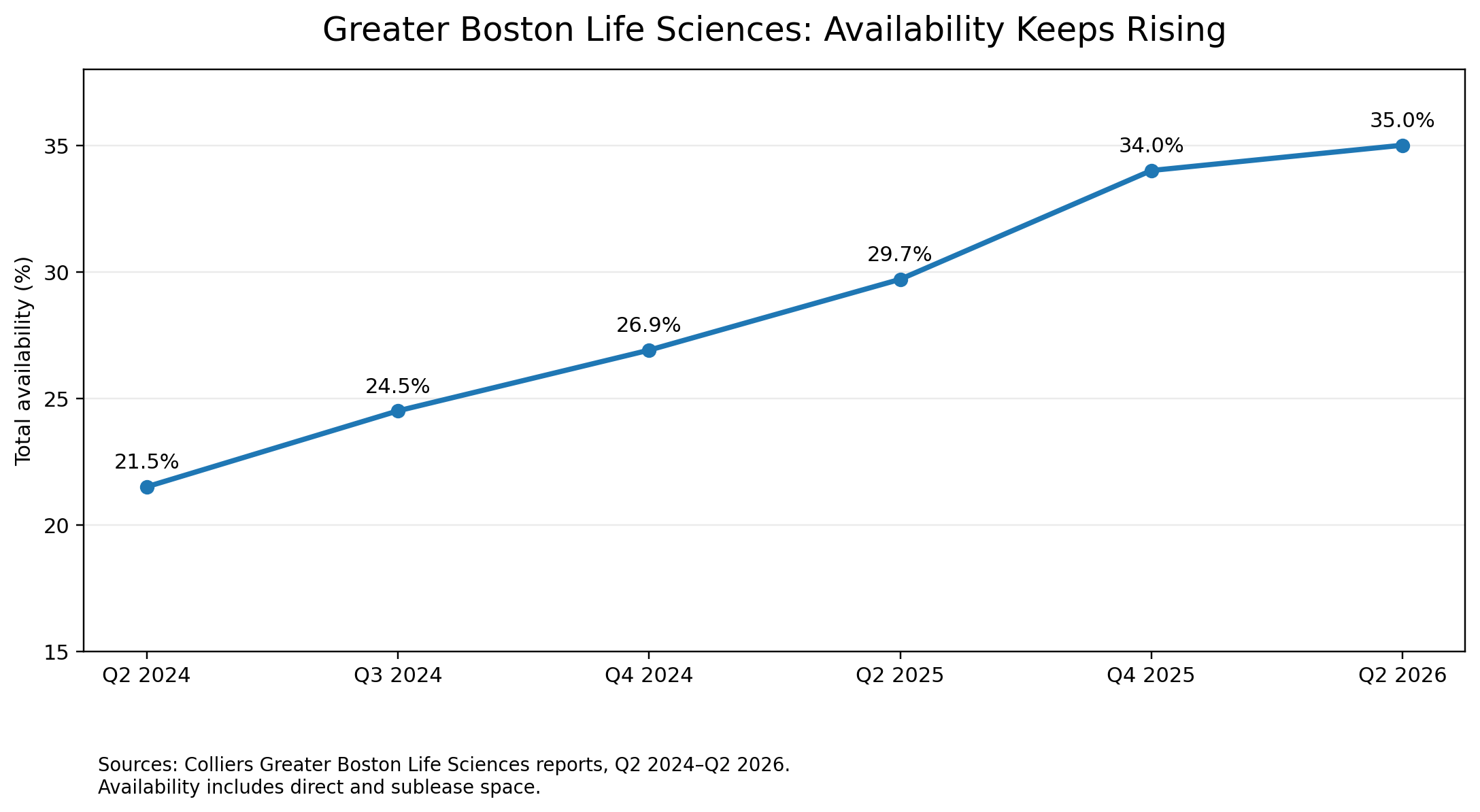
The consequences reach beyond headline vacancy. Prospective tenants can compare multiple high-quality facilities, seek larger concession packages and favor spaces requiring less capital before occupancy. Landlords now compete not only against other buildings but also against sublease inventory and recently completed laboratories that have never been occupied.
For tenants, lease flexibility can become almost as valuable as rental rate. Expansion rights, contraction options, assignment and subletting flexibility, renewal economics, tenant-improvement packages and the ability to avoid overbuilding for projected growth all matter more in a volatile capital environment.
2. Kendall Square Still Matters — But the Market Is Broader
Kendall Square and East Cambridge remain the symbolic and functional center of the Massachusetts biotechnology ecosystem. Geography still matters in a sector where researchers, universities, venture investors, pharmaceutical companies and startups benefit from physical proximity.
The current market, however, gives companies more ability to ask whether they actually need a Kendall Square address. Greater Boston’s expansion created significant clusters in Boston, Somerville, Watertown, Waltham, Lexington and other communities. Worcester and other Massachusetts markets can also become relevant depending on manufacturing, workforce, cost and incentive considerations.
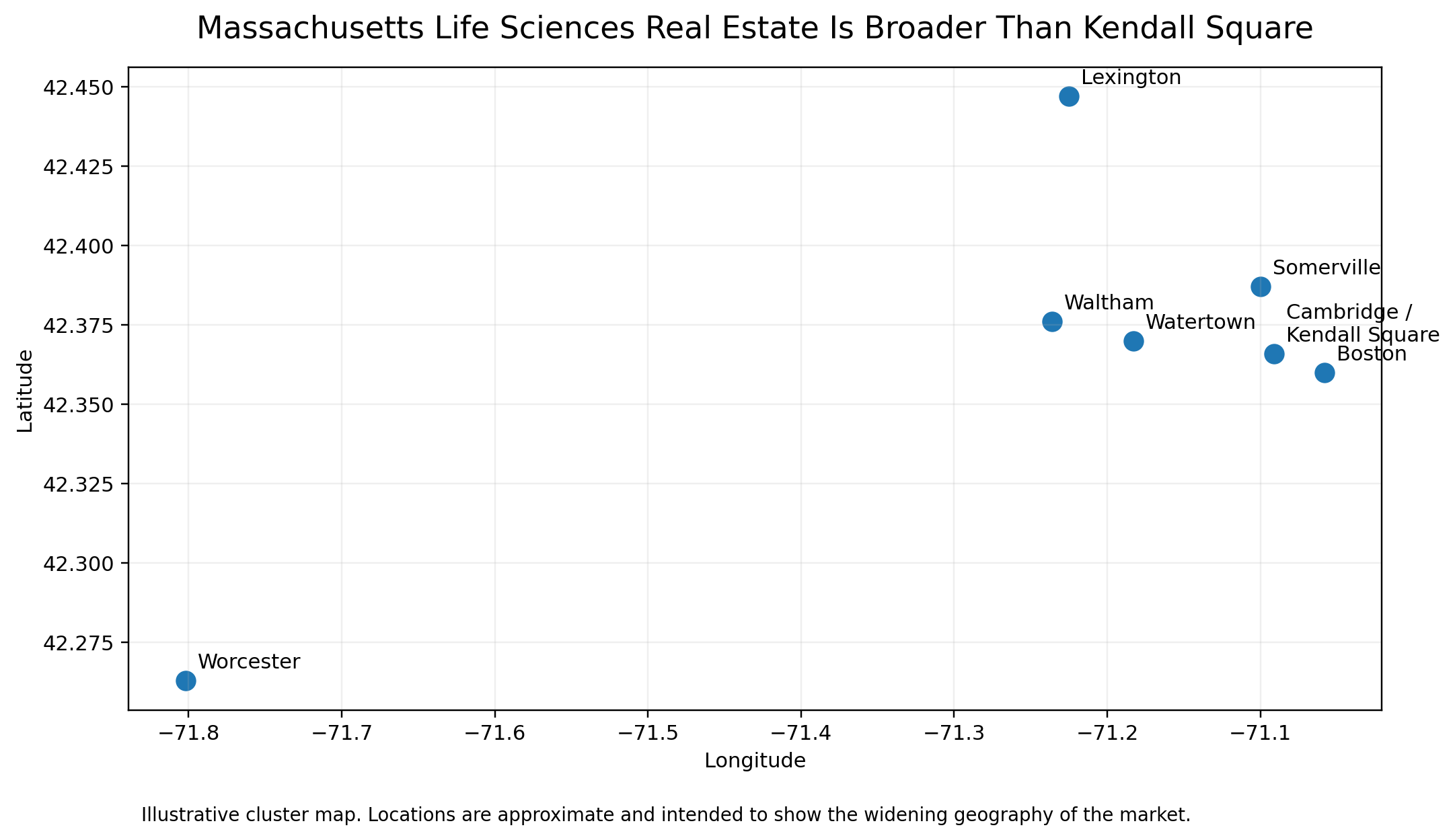
Massachusetts policy reinforces this broader geography. The Mass Leads legislation reauthorized the Massachusetts Life Sciences Initiative for another decade, including $500 million in life sciences investment and an increase in the annual life sciences tax incentive program from $30 million to $40 million. The Massachusetts Life Sciences Center also continues to use incentives to support company expansion and job creation across the Commonwealth.
Real estate therefore becomes part of a larger site-selection calculation. For some companies, proximity to MIT, Harvard, major hospitals and the Cambridge biotechnology network will justify a premium. For others, transportation, infrastructure, workforce access, incentives, expansion capability and occupancy cost may make another Massachusetts location more attractive.
3. The Development Pipeline Is Changing
High vacancy does not necessarily mean that Greater Boston faces an endless stream of new speculative supply. The opposite is beginning to happen. By mid-2026, most life sciences space still under construction was preleased or build-to-suit, while new speculative starts had slowed materially.
That matters because the current oversupply was partly created by projects conceived under very different financing and leasing conditions. With speculative construction sharply reduced, the market has time to absorb existing inventory. Greater Boston also recorded positive life sciences net absorption during the second quarter of 2026 for the first time in approximately two years, with Cambridge contributing significantly to that improvement.
One quarter does not establish a recovery. It does suggest that owners, investors and tenants should distinguish between today’s elevated availability and the amount of competing supply likely to arrive several years from now.
4. Capital Is Returning — But Differently
Real estate demand ultimately follows the companies occupying the buildings. There are reasons for measured optimism. Massachusetts-headquartered biopharma companies raised approximately $3.45 billion in venture capital during the first half of 2026, a 25% year-over-year increase. Eight Massachusetts companies completed IPOs during the first half of the year, equaling the combined total for 2024 and 2025.
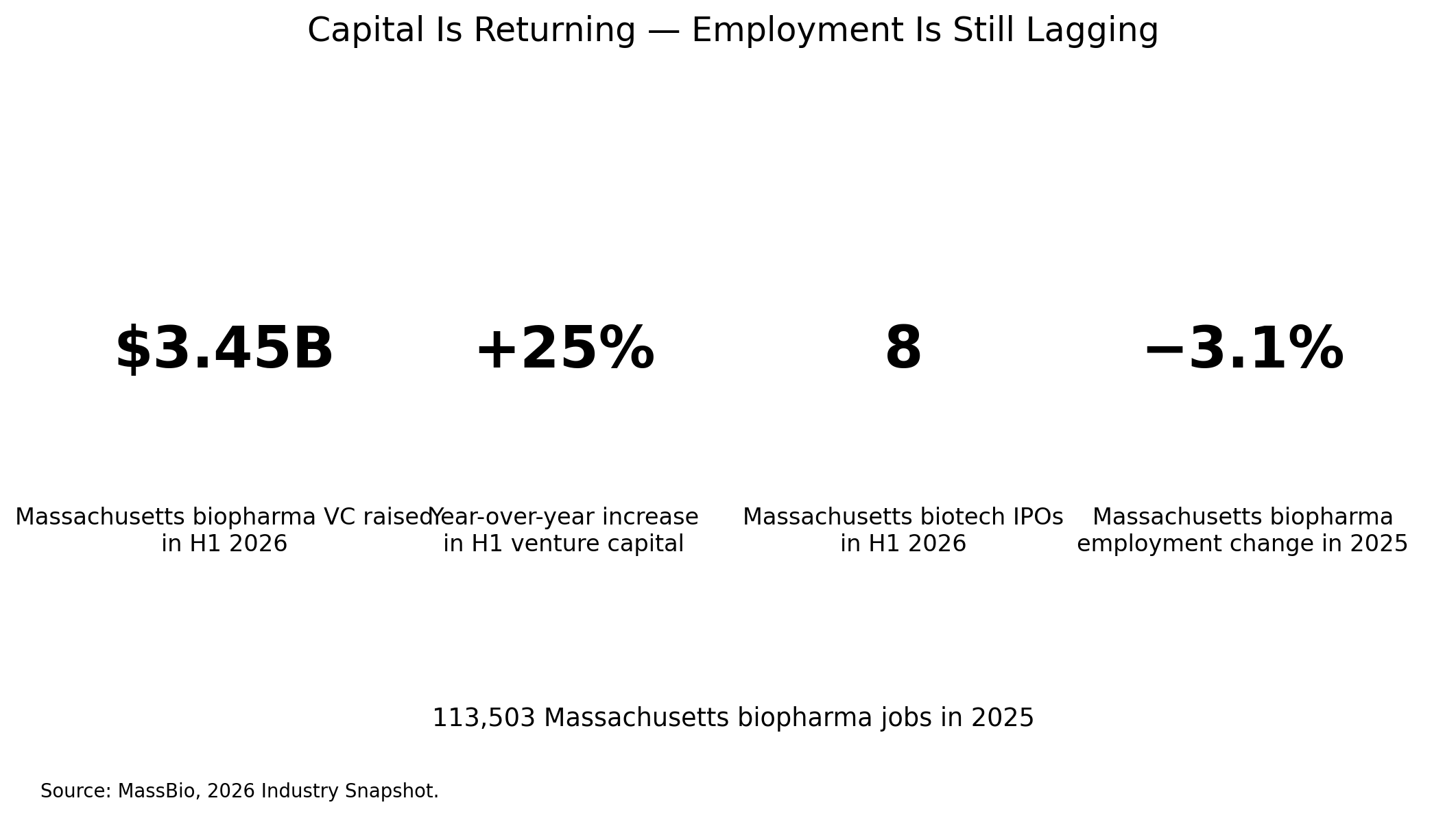
At the same time, Massachusetts biopharma employment declined 3.1% in 2025 to 113,503 jobs, the first annual contraction in more than two decades of tracking by MassBio. Those numbers tell an important story: capital is returning, but companies are likely to remain more disciplined than they were during the prior expansion cycle.
Funding does not automatically translate into immediate large-scale leasing. Companies may prioritize smaller footprints, fitted laboratory space, shorter commitments and expansion options rather than leasing years of anticipated growth in advance. The next life sciences real estate cycle may therefore look materially different from the last one.
5. The Flight to Quality Will Matter
Not every vacant laboratory building is equally positioned to benefit from renewed demand. National market research continues to show tenants gravitating toward newer, higher-quality facilities even while substantial supply remains available.
A laboratory is not merely an office with different finishes. Power capacity, ventilation, floor loading, ceiling heights, backup systems, loading access, hazardous-material handling, vibration control and other building systems can materially affect whether a space works for a particular scientific use.
The result could be an increasingly divided market. Well-located, technically capable buildings that can be occupied with limited additional investment may compete successfully for improving demand. Older or poorly configured laboratory properties may require substantial capital investment, repositioning or consideration of alternative uses.
For investors evaluating discounted or distressed assets, a more useful question than headline price per square foot may be: What will it cost to make this building competitive for its next realistic user?
6. Healthcare Real Estate Adds Another Dimension
The Massachusetts opportunity is broader than biotechnology laboratories. Healthcare delivery continues moving toward outpatient and ambulatory settings, supporting demand for medical office buildings, specialty clinics, ambulatory facilities and other healthcare-oriented real estate.
Massachusetts has an unusually dense network of hospitals, academic medical centers, physician organizations, biotechnology companies and healthcare startups. That creates overlap among traditional medical office space, research facilities, clinical operations, diagnostic uses and emerging healthcare technology companies.
Those uses can raise legal and operational questions that ordinary commercial leases may not adequately address. Permitted-use provisions, zoning, licensing requirements, patient access, assignment rights, exclusivity, hazardous materials, medical waste, equipment installation, data infrastructure, alterations and restoration obligations may all become significant depending on the tenant.
The physical property and the regulatory environment surrounding the occupant cannot always be separated.
7. Real Estate Due Diligence Is Becoming More Important, Not Less
Greater tenant leverage and lower acquisition pricing can make opportunities look compelling. They can also conceal substantial obligations. Before entering a healthcare or life sciences real estate transaction, parties should evaluate:
· zoning and whether the contemplated laboratory, clinical, manufacturing or other specialized use is permitted;
· building systems and whether existing infrastructure can support the intended operation;
· environmental conditions and hazardous-material requirements;
· responsibility for expensive laboratory or medical buildouts;
· ownership and removal of specialized equipment;
· restoration obligations at lease expiration;
· expansion, contraction, assignment and subletting rights;
· regulatory approvals affecting the proposed operation; and
· incentives or economic-development programs that may influence site selection.
Local requirements can be particularly important. Cambridge, for example, regulates development and property uses through its zoning ordinance, with certain proposed uses or developments requiring special permits or other zoning relief. In a fast-moving market, real estate strategy and regulatory strategy should therefore be considered together.
8. The Opportunity in the Reset
Massachusetts did not suddenly lose the ingredients that created one of the world’s leading life sciences ecosystems. The Commonwealth still combines extraordinary research institutions, hospitals, scientific talent, venture capital and established biotechnology and pharmaceutical companies. Massachusetts companies also continue to represent a substantial share of the U.S. drug-development pipeline.
What changed is the real estate market surrounding that ecosystem. A market defined several years ago by scarcity is now defined by choice.
For life sciences and healthcare companies, that creates an opportunity to renegotiate the relationship between facilities and business strategy. For investors and property owners, it places greater importance on asset quality, infrastructure, location and realistic demand. For developers, it argues against assuming that every laboratory project will find a tenant simply because it is located in Greater Boston.
The next phase of Massachusetts healthcare and life sciences real estate will likely reward selectivity rather than speculation. The current correction may ultimately produce a healthier market: one in which companies occupy space because it fits their actual operational needs, capital is deployed more carefully and the strongest properties benefit as the Massachusetts innovation economy works through the excesses of the previous cycle.
Selected Sources
· CBRE, Boston Metro Life Science Figures Q2 2026.
· Colliers, Greater Boston Life Sciences Reports, 2024–2026.
· MassBio, 2026 Industry Snapshot.
· Massachusetts Executive Office of Economic Development, Mass Leads / 2024 Year in Review.
· Massachusetts Life Sciences Center, Tax Incentive Program.
· City of Cambridge, Zoning Ordinance.
· JLL, 2026 U.S. Lab Property Report.
About Lanton, Lanton & Sosa Law PLLC
Lanton, Lanton & Sosa Law advises businesses, investors, healthcare organizations and other clients on legal and regulatory matters affecting commercial real estate, healthcare and life sciences operations. The firm’s work includes commercial transactions, regulatory strategy and government affairs involving organizations operating in Massachusetts and other U.S. markets.
This publication is provided for general informational purposes and does not constitute legal advice.

What Rutledge Still Means for PBM Regulation
What Rutledge and Mulready mean for PBM regulation, pharmacy reimbursement, 340B, network design, contracts and federal oversight.
Pharmacy benefit managers are facing renewed scrutiny from state legislatures, Congress and federal agencies. The central legal issue is not whether PBMs can be regulated. It is which kinds of regulation can survive federal preemption rules.
Our new analysis in Pharmaceutical Executive, “The Legacy of Rutledge: What States and Congress Can Still Regulate Pharmacy Benefit Managers,” examines how the legal framework is developing.
Lanton, Lanton & Sosa Law PLLC advises pharmacies, healthcare organizations, employers and regulated businesses on PBM contracts, reimbursement, pharmacy regulation, 340B, government affairs, compliance and healthcare transactions.
The short version
In Rutledge v. Pharmaceutical Care Management Association, the Supreme Court upheld an Arkansas law requiring PBMs to reimburse pharmacies at or above certain acquisition-cost levels and provide an appeals process.
The Court treated the law as regulation of pharmacy costs. It did not view the statute as directing the design or administration of an ERISA health plan.
The Tenth Circuit’s decision in Pharmaceutical Care Management Association v. Mulready identified a different boundary. Provisions affecting pharmacy networks and preferred-network participation may face preemption when they begin to control how an ERISA plan or Medicare Part D benefit is structured and administered.
The two decisions should be read together:
States retain room to regulate reimbursement, payment practices, MAC lists, dispensing fees and appeals.
States face greater risk when laws dictate network design, benefit structure or plan administration.
Congress can address areas that may be difficult for states to regulate, including PBM compensation, fiduciary duties, ownership, kickbacks, audit rights and pharmacy access.
Why this matters to pharmacy executives
The legal analysis is connected to daily operations. A pharmacy should know what it was paid at the point of sale, what fees were later imposed, how the final reimbursement was calculated and whether the contract provides a meaningful appeal or audit process.
Specialty pharmacies should review whether retail-oriented performance measures accurately reflect complex dispensing, patient-support and clinical services.
Covered entities and contract pharmacies should also examine 340B documentation, manufacturer restrictions, duplicate-discount controls, inventory procedures and audit records.
Employers and plan sponsors should identify direct and indirect PBM compensation, affiliated arrangements, spread pricing, formulary incentives and the practical value of their audit rights.
What to review now
A focused review should cover:
PBM reimbursement and reconciliation data.
MAC-list and appeal procedures.
Contract terms governing audits, fees and termination.
Network and specialty-pharmacy provisions.
340B contract-pharmacy and documentation practices.
The effect of new federal reporting and fiduciary requirements.
The policy debate will continue through legislation, litigation, agency action and contract negotiations. The organizations best prepared for the next phase will be the ones that understand their contracts, payment data and operational records before a dispute begins.
Read the full analysis in Pharmaceutical Executive: The Legacy of Rutledge: What States and Congress Can Still Regulate Pharmacy Benefit Managers.
This article is for general informational purposes only and does not constitute legal advice.

Kendall Square Lab Space: What Life Sciences Companies Should Consider Before Signing Their Next Lease
Kendall Square remains a global life sciences hub, but the market for laboratory space has changed. Greater availability is giving companies an opportunity to look beyond rent and negotiate for greater flexibility in buildouts, assignments, expansion rights and future transactions.
Kendall Square remains one of the world’s leading life sciences centers. The market for laboratory space surrounding it, however, looks very different from just a few years ago. For biotechnology and life sciences companies, the shift creates an opportunity to reconsider not simply where they operate, but whether their next lease fits their business plans.
The market has shifted, and tenants have more choices
CBRE reported Greater Boston laboratory vacancy of 28.7% in the second quarter of 2026, with availability at 32.8%. Cambridge recorded nearly 194,000 square feet of positive absorption in the quarter, but substantial available space and softer rents continue to give many prospective tenants negotiating options. Different research firms calculate availability using different inventories and methods; the chart below uses Colliers figures and should not be read as CBRE’s series.
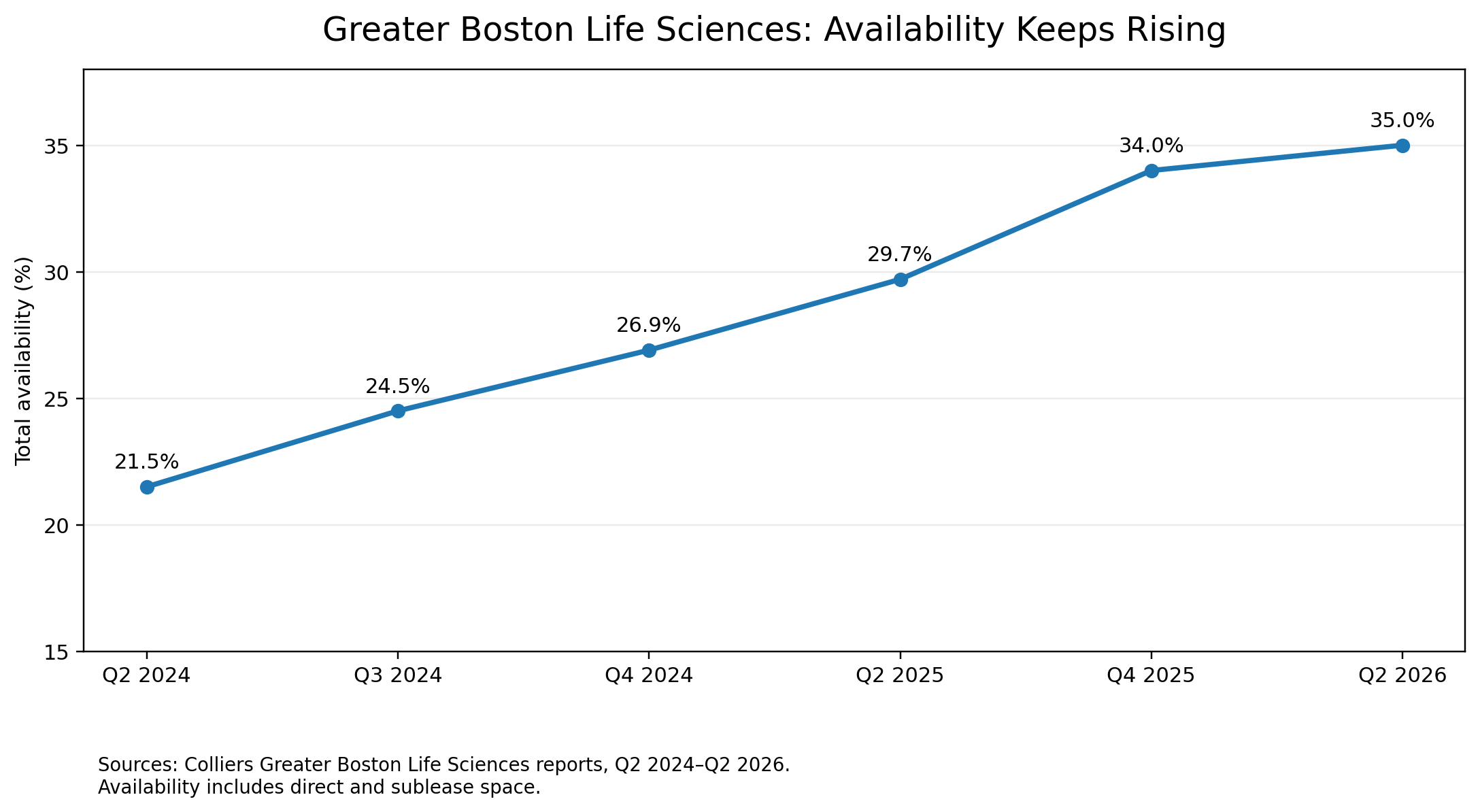
A company entering a new lease, renewing existing space or considering expansion may have more choices than during the market’s rapid expansion. The resulting leverage should extend beyond rental rate. Laboratories require specialized power, ventilation, equipment and other infrastructure. A rent concession has limited value if the company must fund substantial improvements or cannot occupy the facility when needed.
A lower rent does not necessarily mean a better lease
Before selecting a facility, companies should establish whether the building can support the intended research, clinical or manufacturing use. That means examining permitted uses, hazardous-material restrictions, building systems, responsibility for specialized improvements and the point at which rent begins if construction or delivery is delayed.
Tenant-improvement allowances, construction milestones and obligations to maintain or replace specialized systems all deserve careful attention. If a landlord contributes to the initial buildout, the lease should also make clear which equipment belongs to the tenant and what must be removed or restored when the lease ends.
Kendall Square matters, but companies have alternatives
The advantages of proximity to MIT, major hospitals, researchers and investors remain important. Yet Cambridge is no longer the only location worth evaluating. Depending on the business, Somerville, Boston, Watertown, Waltham, Lexington or Worcester may offer different combinations of costs, workforce access, infrastructure, incentives and room to expand.
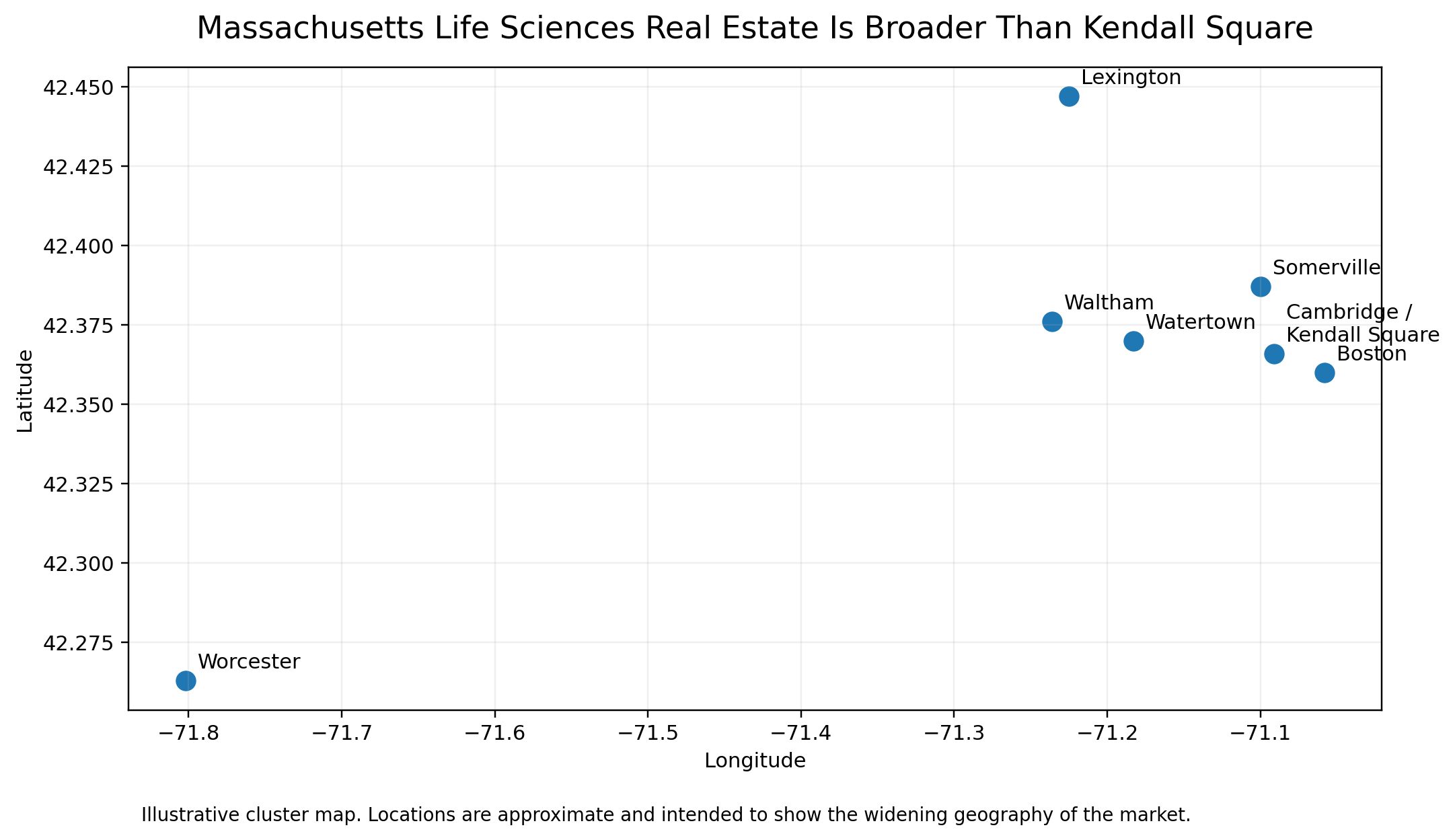
Location is ultimately a business decision, but it can carry legal consequences. Zoning, permitted laboratory use, environmental requirements and local approvals should be assessed before a company commits to a property or bases its financing assumptions on a particular occupancy date.
Your lease needs to accommodate what happens next
A biotechnology company’s space requirements can change quickly. It may raise capital, add a development program, enter a partnership, downsize, acquire another business or become an acquisition target. A lease negotiated only for today’s footprint can become an obstacle to tomorrow’s transaction.
Expansion and contraction options, renewal terms, assignment rights, sublease restrictions and change-of-control provisions deserve attention at the outset. For example, a company pursuing an acquisition may discover that a proposed transaction triggers a landlord-consent requirement. A company conserving capital may find that it cannot sublease space it no longer needs. The relevant flexibility is easier to negotiate before the lease is signed.
Capital is returning, but real estate decisions still require discipline
The Massachusetts market presents a mixed picture. MassBio reported approximately $3.45 billion in venture capital raised by Massachusetts-headquartered biopharma companies in the first half of 2026, a 25% increase from the same period a year earlier. At the same time, biopharma employment fell 3.1% in 2025. Improving financing does not necessarily translate into immediate demand for large, long-term laboratory leases.
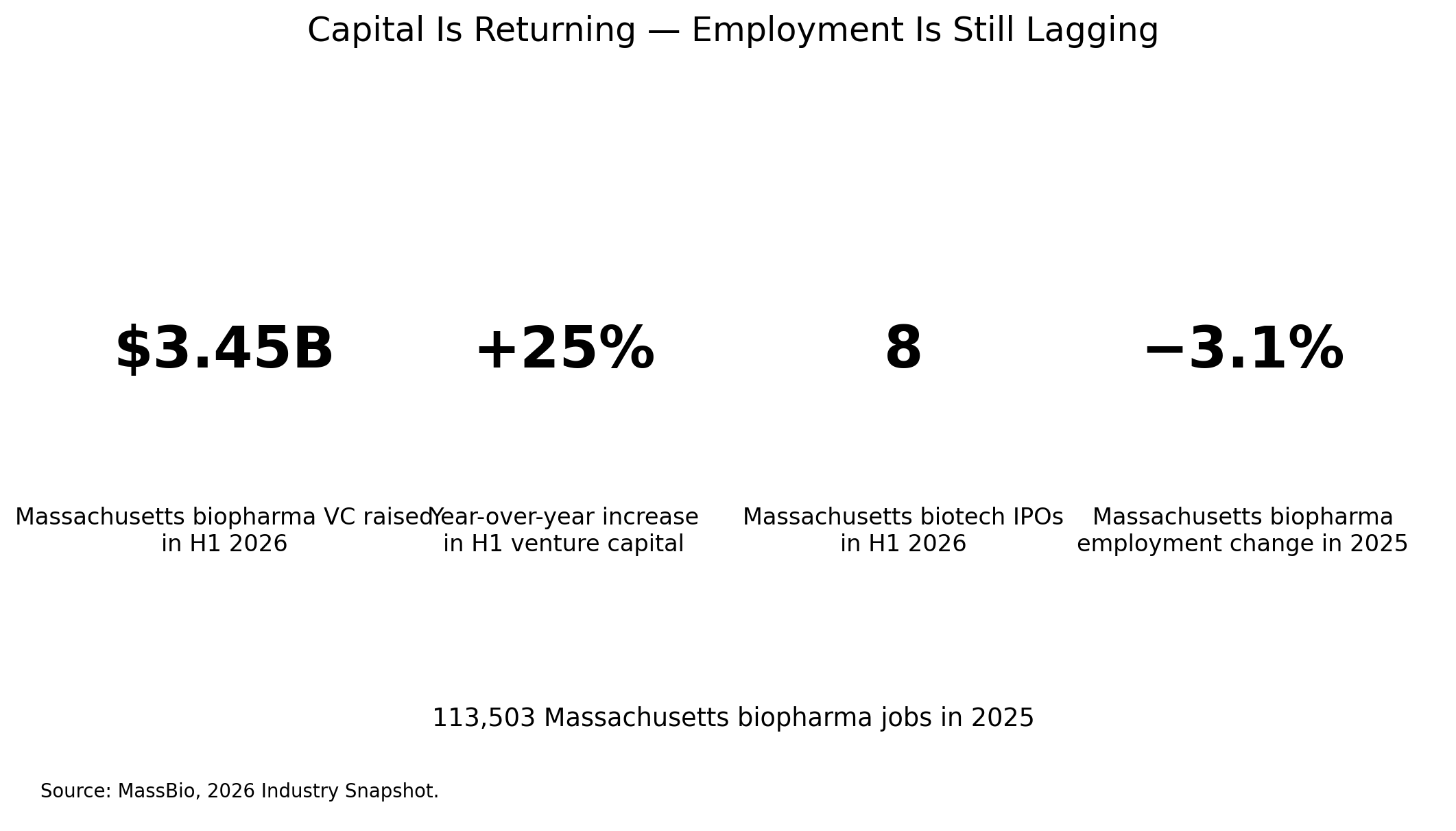
For a growing company, that combination reinforces the need to evaluate occupancy costs against cash runway, anticipated milestones and the possibility of changes in staffing or research priorities. For an investor reviewing a portfolio company, lease obligations can also affect the economics of financing, restructuring or a sale.
Where legal review can protect the business
Life sciences leases call for more than a review of standard commercial terms. Before a company commits to a facility, legal counsel can help the business evaluate:
Tenant-improvement allowances, buildout responsibility and remedies for construction or delivery delays.
Permitted uses, zoning, hazardous materials and operational requirements for research or other regulated activities.
Expansion, contraction, renewal, assignment and subleasing provisions.
Ownership and removal of specialized equipment, decommissioning and restoration obligations.
Change-of-control provisions that may affect financings, acquisitions or reorganizations.
These issues are interconnected. A company may obtain favorable rent only to assume restoration costs that become significant when it exits. A strong tenant-improvement package may be less useful if a lease limits the company’s ability to expand or transfer space during a corporate transaction.
Putting the current market to work
Greater Boston’s market gives life sciences companies an opportunity to negotiate lease terms with greater attention to their actual operating and financial needs. The objective should not be to secure the lowest rental rate. It should be to enter an agreement that supports the company’s scientific work and leaves room to respond to changes in financing, growth and corporate strategy.
Lanton, Lanton & Sosa Law works with life sciences companies, investors and other businesses on commercial real estate transactions, including lease negotiations, contractual risk and the corporate and regulatory issues that can accompany laboratory expansion and relocation.
Selected sources
CBRE, Boston Metro Life Science Figures, Q2 2026.
Colliers, Greater Boston Life Sciences reports, Q2 2024–Q2 2026.
MassBio, 2026 Industry Snapshot.
City of Cambridge, Zoning Ordinance.
This publication is provided for general informational purposes only and does not constitute legal advice.

Employers, Be Careful How You Classify Employees
Paying an employee a salary does not automatically make that employee exempt from overtime. Employers should understand how job duties, classification rules, and changing responsibilities can create unexpected wage-and-hour liability.
One of the easiest wage-and-hour mistakes a business can make is assuming that a salaried employee is automatically exempt from overtime.
That is not always true.
Under the Fair Labor Standards Act, most covered employees are entitled to overtime when they work more than 40 hours in a workweek unless a specific exemption applies. Job titles and salary alone do not determine exempt status. The employee’s actual duties matter.
This becomes a problem when employers work backwards. A company decides that a position should not receive overtime, labels the employee “salaried” or “exempt,” and assumes the issue is resolved.
It is not.
A manager who spends most of the day performing the same work as everyone else may not qualify for the executive exemption. An office employee who performs important work may not automatically qualify for the administrative exemption either.
Employers should also remember that jobs change. Responsibilities evolve, companies reorganize, and employees may take on or lose duties over time. A classification that was appropriate when someone was hired may not remain appropriate years later.
That is why employers should periodically review exempt classifications and ask a simple question:
Why does this employee qualify for the exemption?
If the answer is simply, “because the employee is salaried,” “because we call the employee a manager,” or “because everyone in that department is exempt,” it may be time for another look.
Misclassification does not have to be intentional to create liability. Unpaid overtime can accumulate quietly over months or years.
The key point is simple: salary and exempt are not the same thing.
Employers should classify employees based on the law and the work they actually perform, not based on the payroll result the company would prefer.

AI + Healthcare, Part 3: AI’s Next Phase Is About Control, Not Speed
AI’s next phase will be defined not only by technical speed, but by governance, data protection, accountability and measurable value.
The first two pieces in this series examined two problems: AI may develop treatments faster than insurers can pay for them, and approved products may keep changing after regulators clear them.
The next issue is control.
AI companies have spent years competing on speed and capability. Now investors, enterprise customers and health systems are asking a more practical question:
Can this technology be governed, protected and turned into measurable value?
Recent developments show the technology industry beginning to wrestle with the limits of acceleration. Public debate around frontier-model development is becoming more pointed, while Microsoft has proposed limits on how its AI models may be used even as it continues to invest heavily in the technology.
CNBC on Anthropic CEO Dario Amodei
CNBC on Microsoft’s AI model limits
This is not necessarily a retreat from AI. It is a move from “How fast can it improve?” to “Can organizations use it safely and reliably?”
Control is becoming part of the product
Enterprise buyers want straightforward answers. What happens to their data? Can the system’s output be audited? Who is responsible when the model changes? Can its use be limited? Will the vendor provide notice before a major update? Can the company show a return on the investment?
Those questions are becoming part of the product itself.
A less powerful system that can be monitored and integrated into a company’s workflow may be more valuable than a more advanced system that creates uncertainty around data, liability or reliability. Technical capability still matters, but capability without control can become a business problem.
For healthcare organizations, that distinction is even more important.
Healthcare cannot treat every update as routine
AI-enabled products may change through new data, software releases or revised algorithms. Some updates fix technical issues. Others may alter recommendations, intended use, patient population or risk profile.
Leadership needs a process for evaluating and documenting those changes before release.
FDA authorization does not resolve every post-approval question. A hospital may ask whether an update changes its workflow or liability exposure. A payer may want new evidence. Providers may need additional training. Contracts may need to address version control, cybersecurity and responsibility for errors.
The faster a product changes, the more important its governance becomes.
Investors will look beyond the model
Technical performance will remain important, but it will not be enough. Investors will also want to know whether a company can protect customer data, maintain reliable performance, demonstrate outcomes, manage regulatory obligations and control deployment.
They will also ask whether usage can become recurring revenue.
That makes governance part of the company’s infrastructure and valuation story. A company that can explain how its system is monitored, updated and protected may be easier to finance, partner with and scale.
The winners may not be the companies that move fastest in every direction. They may be the companies that understand where speed creates value and where discipline protects it.
Five questions executives should ask
Before deploying an AI system, leadership should be able to explain what decision the system is helping someone make. That sounds simple, but it forces the organization to define the system’s purpose instead of treating AI as a general solution.
Leadership should also understand what data the system uses and who controls that data. That includes questions about ownership, confidentiality, access, retention and whether information is used to train or improve another system.
The organization should know how updates will be tested and documented. A software change may be minor, or it may affect performance, workflow or patient risk. The company needs a way to tell the difference.
Someone must remain responsible for the outcome. AI may assist with a decision, but responsibility cannot be assigned to the software. Contracts, internal policies and operating procedures should reflect that reality.
Finally, leadership should define what evidence will show that the system creates value. That may involve better outcomes, lower administrative costs, faster development, improved patient access or a more reliable workflow. Without a clear measure, adoption can become expensive experimentation.
These questions apply to drug development, diagnostics, clinical software, health-system operations and administrative tools.
They also affect the supporting contracts. Data rights, intellectual property, confidentiality, audit access, cybersecurity, indemnification, performance standards and termination rights all become more important when a product can change after it is deployed.
The next AI advantage
AI should continue improving. The market should continue testing what it can do.
The companies best positioned to succeed will understand that control is not the enemy of speed. Control is what allows speed to become something customers, regulators, investors and patients can actually use.
Lanton Strategies International helps healthcare and life-sciences companies understand the policy, reimbursement, market-access and commercial questions that determine whether innovation can move from development into sustainable use.
Lanton, Lanton & Sosa Law PLLC advises healthcare and life-sciences companies, technology businesses and other regulated organizations on the legal issues that arise as products and services enter the market, including contracts, data rights, intellectual property, cybersecurity, regulatory compliance, commercial arrangements and liability.
Together, LSI and the law firm help clients evaluate both sides of the same question: how to turn innovation into a product or service that can be deployed, protected, reimbursed and built to last.
Earlier in the series:
Part 1: What Happens When AI Develops Drugs Faster Than Insurers Can Figure Out How to Pay for Them?
Part 2: What Happens When the Product Keeps Changing After Approval?
This article is for general educational and informational purposes only. It is not legal advice and does not create an attorney-client relationship.

The Legal Questions Behind a Pharmaceutical Manufacturing Move
A pharmaceutical manufacturing move involves real estate, FDA compliance, incentives, trade rules, contracts and long-term operational risk.
A pharmaceutical company considering a new U.S. manufacturing site is not making a single decision. It is taking on a series of legal, regulatory and commercial questions at the same time.
Ipsen is reportedly evaluating whether to establish a U.S. manufacturing facility while continuing to invest in its U.K. operations. No final decision has been announced. Still, the issue illustrates what companies must examine when production strategy begins to shift. The Wall Street Journal, September 11, 2026
The first question is whether the company should build, acquire, expand an existing facility or use a contract manufacturer. Each path creates different obligations involving financing, real estate, construction, environmental review, licensing, employment and supply agreements.
The regulatory analysis is just as important. A facility may need to meet FDA requirements, address changes to manufacturing processes and maintain compliance during a transition. Moving production from one country to another can also affect inspections, documentation, release procedures and responsibilities between related companies and outside vendors.
Government incentives add another layer. Tax credits, grants and other programs may make a U.S. project more attractive, but they often come with eligibility rules, reporting requirements, employment commitments or limits on how funds may be used.
Trade policy also matters. Tariffs, country-of-origin rules and future changes in U.S. policy can affect the economics of a facility long after the initial investment decision has been made.
The legal work should begin before a company chooses a site. By then, the company should understand the regulatory pathway, the incentives it may qualify for, the contractual structure it needs and the risks of changing production later.
Manufacturing strategy is now part of the broader business strategy. Companies that treat it as only a real-estate or operations project may miss the legal and commercial consequences.
At Lanton, Lanton & Sosa Law PLLC, we help healthcare and life-sciences companies think through the legal, regulatory and government-affairs issues that arise when manufacturing, investment and market strategy begin to overlap. The earlier those questions are addressed, the more options a company usually has.
This article is for general educational purposes only and does not constitute legal advice. Specific manufacturing, regulatory, incentive and transactional questions should be reviewed with qualified counsel.

Health Law Questions Healthcare Leaders Are Facing Now
A preview of the Massachusetts Bar Association Health Law Section’s October 8 conference, where Ron Lanton will join other speakers to discuss PBM reform, reimbursement, medical autonomy, reproductive justice, and artificial intelligence in healthcare.
The Massachusetts Bar Association’s Health Law Section will hold its annual conference on Thursday, October 8, from 12:30 to 5:30 p.m. I’ll be participating as one of the speakers, with the discussion focused on the legal and practical issues healthcare organizations are facing now.
The program will cover PBM reform, reproductive justice, medical autonomy, reimbursement, and artificial intelligence in healthcare.
They may be listed as separate topics, but healthcare organizations often have to deal with them at the same time.
A reimbursement rule can affect whether a patient receives care. PBM policies can change how pharmacies and providers operate. New technology can raise questions about privacy, responsibility, reimbursement, and professional judgment. Political and regulatory decisions can affect how organizations plan and invest.
The common thread is practical risk. Healthcare leaders have to understand not only what a rule says, but how it will affect operations, patient care, employees, and business decisions.
Artificial intelligence makes that challenge more immediate. Healthcare organizations are adopting tools for research, administration, diagnosis, and communication, often before the legal and regulatory expectations are fully settled. That makes oversight, documentation, privacy, and accountability important questions to address early.
The conference will bring together healthcare attorneys and other professionals to discuss these issues in a practical setting. I’m looking forward to joining the other speakers and contributing to the conversation.
The event will be held in person at the Massachusetts Bar Association. Registration is available through the Massachusetts Bar Association’s Health Law Section.
This article is for general educational purposes only and does not constitute legal advice. Healthcare law depends on the specific facts and applicable law. Organizations should consult qualified counsel regarding their circumstances.

U.S. Most-Favored-Nation Drug Pricing Raises Questions Beyond the Price of Medicines
U.S. most-favored-nation drug pricing could affect far more than what Americans pay for medicines. Ron Lanton examines the potential impact on pharmaceutical launch sequencing, existing products, antitrust considerations and international markets, including Switzerland, following recent coverage by APM Market Access.
The renewed focus on most-favored-nation drug pricing in the United States is often discussed as a straightforward question of whether the government can bring American drug prices closer to those paid in other countries. The consequences could be much broader.
I recently spoke with Jen Brogan of APM Market Access about several of those issues, including how pharmaceutical manufacturers may approach future drug launches, what happens when pricing decisions in one country begin affecting another market, and whether countries outside the United States could face additional pressure as the policy develops.
One of the biggest questions is launch sequencing. Pharmaceutical companies do not make launch decisions one country at a time without considering what happens elsewhere. If a lower price negotiated in one market can eventually influence the price available in the United States, companies may have to reconsider where and when certain products are introduced. The answer may also differ considerably depending on the drug, its patient population, available alternatives and the economics surrounding the product.
APM Market Access examined that issue in “U.S. MFN could shift pharma launch sequencing ‘per class of drug’ – legal expert”.
The policy may also affect products already on the market differently from new medicines. Existing products already have established pricing, reimbursement arrangements and commercial expectations across multiple countries. That can make changing the economics surrounding those products particularly complicated.
APM addressed that question in “MFN could put greater short-term pressure on existing drugs than new launches – pricing expert”.
There is also a legal issue that deserves attention. International reference pricing can create situations where pricing information or arrangements in one market begin influencing decisions in another. That does not automatically create an antitrust problem. It does mean companies need to pay close attention to how pricing information is obtained, communicated and used when commercial decisions are being made across markets.
That issue was discussed in “U.S. MFN policy raises potential ‘antitrust’ questions over cross-market drug pricing, says legal expert”.
Finally, this is not only a U.S. policy discussion. Countries with significant pharmaceutical industries and comparatively lower medicine prices may find themselves part of the debate.
Switzerland is a particularly interesting example. It is home to some of the world's largest pharmaceutical companies, while the country is also dealing with its own questions about pharmaceutical competitiveness, research investment and the economics of maintaining a strong life sciences sector. If the United States places greater importance on international price comparisons, Switzerland and other European markets could face difficult choices between controlling domestic healthcare spending and maintaining an environment that attracts pharmaceutical investment.
APM explored that issue in “Switzerland could become target of U.S. pressure on drug pricing, says legal expert”.
Taken together, these questions illustrate why MFN cannot be evaluated solely by looking at the price of a prescription today. Drug pricing policy can affect launch decisions, investment, competition, reimbursement and the relationship between pharmaceutical markets around the world.
For pharmaceutical manufacturers, healthcare organizations, policymakers and investors, the important question will be how those consequences develop as the policy moves from announcement to implementation.
APM Market Access Coverage
U.S. MFN could shift pharma launch sequencing ‘per class of drug’ – legal expert
APM Market Access
MFN could put greater short-term pressure on existing drugs than new launches – pricing expert
APM Market Access
U.S. MFN policy raises potential ‘antitrust’ questions over cross-market drug pricing, says legal expert
APM Market Access
Switzerland could become target of U.S. pressure on drug pricing, says legal expert
APM Market Access
The APM Market Access articles are available through APM Market Access and may require a subscription.

AI Can Help HR. It Shouldn’t Make Your Employment Decisions
AI can be a useful HR tool, but it should not make legal employment decisions. Terminations, accommodations, workplace complaints, leave issues and investigations often depend on facts, history and legal considerations that AI may never see. Employment counsel can help companies understand the risk before a decision becomes a problem.
AI is becoming part of everyday business, and HR is no exception. It can help organize information, draft a job description, summarize a policy or help a manager prepare for a meeting. Where companies can get into trouble is using AI to answer the legal question behind an HR problem.
An executive may have an employee who has been underperforming. A manager may want to terminate someone. An employee may ask for an accommodation, raise a complaint about a supervisor or question their pay, leave or job classification. It is easy to type the situation into an AI program and ask, “Can we do this?” That is where I would be careful.
HR problems usually have a history. What happened six months ago can matter just as much as what happened today. Was the employee previously disciplined? Did the employee recently complain about discrimination, wages, safety or another workplace issue? Has the company treated other employees the same way? Is there a medical issue, leave request or accommodation involved? What has the manager already said in emails, text messages or prior meetings?
Those facts can completely change the legal analysis. AI only knows what you tell it. An employment lawyer should be asking about the things you may not realize matter.
Executives understandably want direct answers, especially when a personnel issue is taking up time and creating disruption. Sometimes there is a straightforward answer. Other times, the right answer is, “Let me see the documentation first.” A termination that looks simple may raise questions involving discrimination, retaliation, protected leave, disability accommodation, wage issues, an employment agreement or the company’s own policies.
The same applies to discipline, compensation changes, internal investigations and responses to employee complaints. The legal issue is often not simply whether the company has a reason to act. It is whether the company can explain and defend how it acted.
Consistency also matters. If two employees engage in similar conduct and one is terminated while the other receives a warning, there may be a perfectly legitimate explanation. There may also be a problem. AI does not know how your company handled a similar situation last year unless someone gives it that history. It does not know what another manager may have promised, what prior complaints were made or why one employee’s situation is different from another’s.
There is also another practical concern. HR departments deal with some of the most sensitive information inside a company. Employee medical information, compensation, workplace complaints, investigations, performance concerns and potential litigation should not automatically be copied into an AI platform simply because it is convenient. Companies should understand what AI tools their employees are using, what information is being entered into them and what internal rules apply.
None of this means AI should be avoided in HR. Used properly, it can save time and make people more efficient. The important distinction is between using AI to assist with the work and using it to make the legal judgment.
Use AI to help organize the question. Use your employment lawyer to help answer it.
When the issue involves a termination, workplace complaint, accommodation, leave request, wage question, investigation or another decision that could create legal exposure, a short conversation with counsel before the company acts can be much more valuable than trying to fix the decision afterward. In HR, one email, one conversation or one poorly handled decision can become detrimental later.
This article is for general educational purposes only and does not constitute legal advice. Employment law questions depend on the specific facts and applicable law. Employers should consult qualified counsel regarding their particular circumstances.

Lowell’s Data Center Dispute Offers a Warning for Massachusetts Developers
A Lowell court dispute shows why Massachusetts data-center developers and municipalities must address permitting, backup power, land use and community concerns early.
Massachusetts is beginning to see the practical legal consequences of the data-center boom.
A recent dispute in Lowell involved a large facility operated by the Markley Group near residential neighborhoods. Residents challenged aspects of the facility’s air permitting and asked the court to stop the installation of four additional diesel generators.
On August 10, 2026, a Massachusetts Superior Court judge granted that request while the case continues. The order did not shut down the entire facility or cancel every existing approval. It stopped installation of the four generators that had not yet been installed.
That narrow result is important. A project can have regulatory approvals and still face a targeted court challenge that affects construction, operating capacity and financing.
Why backup power matters
Large data centers need dependable electricity. Backup generators may be necessary, but they also create questions about emissions, noise, fuel,, testing, operating hours and proximity to homes or other sensitive locations.
Those questions can become part of an air-permit challenge, a local hearing or a broader dispute over whether the project’s effects were fully considered.
Before filing or expanding a project, developers should determine which permits are required for the generators and related equipment, what operating limits apply, whether emissions and noise were adequately documented, whether the expansion requires a new or modified approval, and how a potential delay could affect financing, construction and service commitments.
Location changes the risk
A facility near established neighborhoods will draw more attention than one in a remote industrial area. Residents may raise concerns about noise, diesel emissions, water use, traffic and property values. Those concerns can lead to administrative appeals, litigation or political pressure for new restrictions.
The environmental-justice dimension also matters. Communities want understandable information about the project and a meaningful opportunity to participate before major infrastructure is installed.
What municipalities should consider
Municipalities should make sure their zoning and permitting procedures clearly address data centers and related equipment. They should apply standards consistently, obtain enough technical information to evaluate the proposal and create a record showing how public concerns were considered.
Informal or inconsistent conditions may create problems later for both the town and the developer.
The practical lesson
The Lowell case does not decide whether Massachusetts should approve or reject data centers. It does make one point clear: a permit is not the end of the process.
Developers should address power, backup generation, environmental effects and community concerns before construction begins. Municipalities should be prepared to explain how their rules apply and why their decisions are supported by the record.
Projects that plan for those issues early will be in a stronger position when the next proposal reaches a public hearing—or a courtroom.
This article is provided for educational and informational purposes only. It is not legal advice and does not create an attorney-client relationship. Lanton, Lanton & Sosa Law PLLC can advise clients on matters involving land use, permitting, infrastructure and related regulatory issues.