
Massachusetts Healthcare & Life Sciences Real Estate From Scarcity to Selectivity: A Market Reset Creates a New Set of Opportunities
Executive Summary
Massachusetts remains one of the world’s most important healthcare and life sciences markets, but the real estate environment surrounding that ecosystem has changed dramatically. Several years ago, companies competed for laboratory space in Cambridge and Greater Boston. Today, tenants have materially more choice, owners face elevated vacancy and sublease competition, and speculative development has slowed sharply.
The result is not the disappearance of the Massachusetts life sciences market. It is a transition from scarcity to selectivity. Companies can now evaluate space based on economics, flexibility, infrastructure, location and speed to occupancy rather than availability alone. Owners and investors must distinguish between assets that can compete for the next generation of demand and properties that may require substantial repositioning.
This mini-white paper examines the implications of that reset for tenants, developers, owners, investors and healthcare operators considering Massachusetts real estate decisions.
1. The Market Reset: From Scarcity to Tenant Leverage
The speed of the shift is striking. During the expansion cycle, laboratory demand and limited supply encouraged aggressive development, including substantial speculative construction. That pipeline arrived as biotechnology companies began conserving capital, reducing headcount, consolidating operations and returning unwanted space to the market.
By the second quarter of 2026, total life sciences availability in Greater Boston was roughly 35%, with more than 20 million square feet listed as available. CBRE separately reported a 28.7% vacancy rate and 32.8% availability rate for the Boston metropolitan life sciences market during the same quarter. The precise figures vary by source and methodology, but the direction is unmistakable: Greater Boston moved from a landlord-favored scarcity market to one where tenants have meaningful leverage.
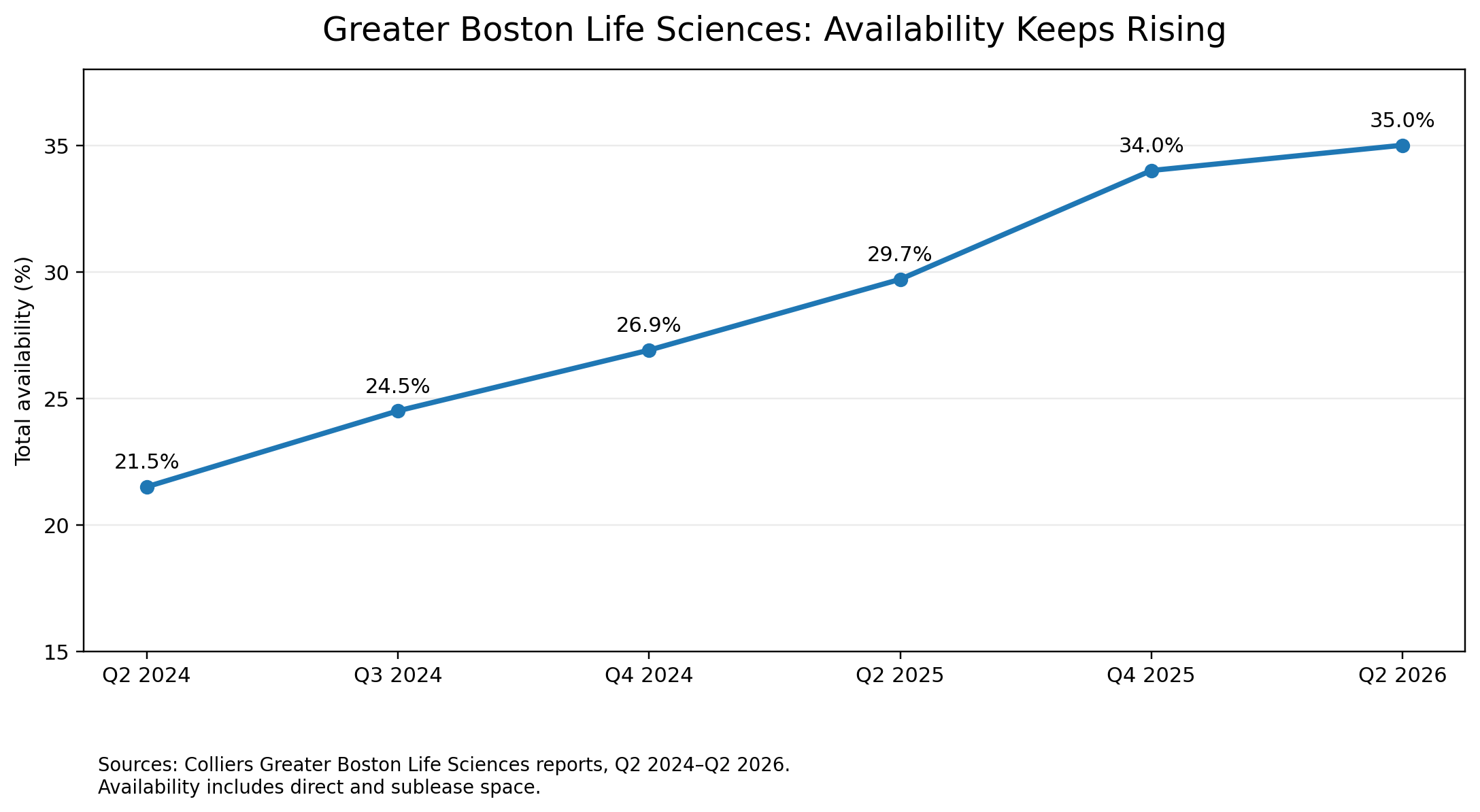
The consequences reach beyond headline vacancy. Prospective tenants can compare multiple high-quality facilities, seek larger concession packages and favor spaces requiring less capital before occupancy. Landlords now compete not only against other buildings but also against sublease inventory and recently completed laboratories that have never been occupied.
For tenants, lease flexibility can become almost as valuable as rental rate. Expansion rights, contraction options, assignment and subletting flexibility, renewal economics, tenant-improvement packages and the ability to avoid overbuilding for projected growth all matter more in a volatile capital environment.
2. Kendall Square Still Matters — But the Market Is Broader
Kendall Square and East Cambridge remain the symbolic and functional center of the Massachusetts biotechnology ecosystem. Geography still matters in a sector where researchers, universities, venture investors, pharmaceutical companies and startups benefit from physical proximity.
The current market, however, gives companies more ability to ask whether they actually need a Kendall Square address. Greater Boston’s expansion created significant clusters in Boston, Somerville, Watertown, Waltham, Lexington and other communities. Worcester and other Massachusetts markets can also become relevant depending on manufacturing, workforce, cost and incentive considerations.
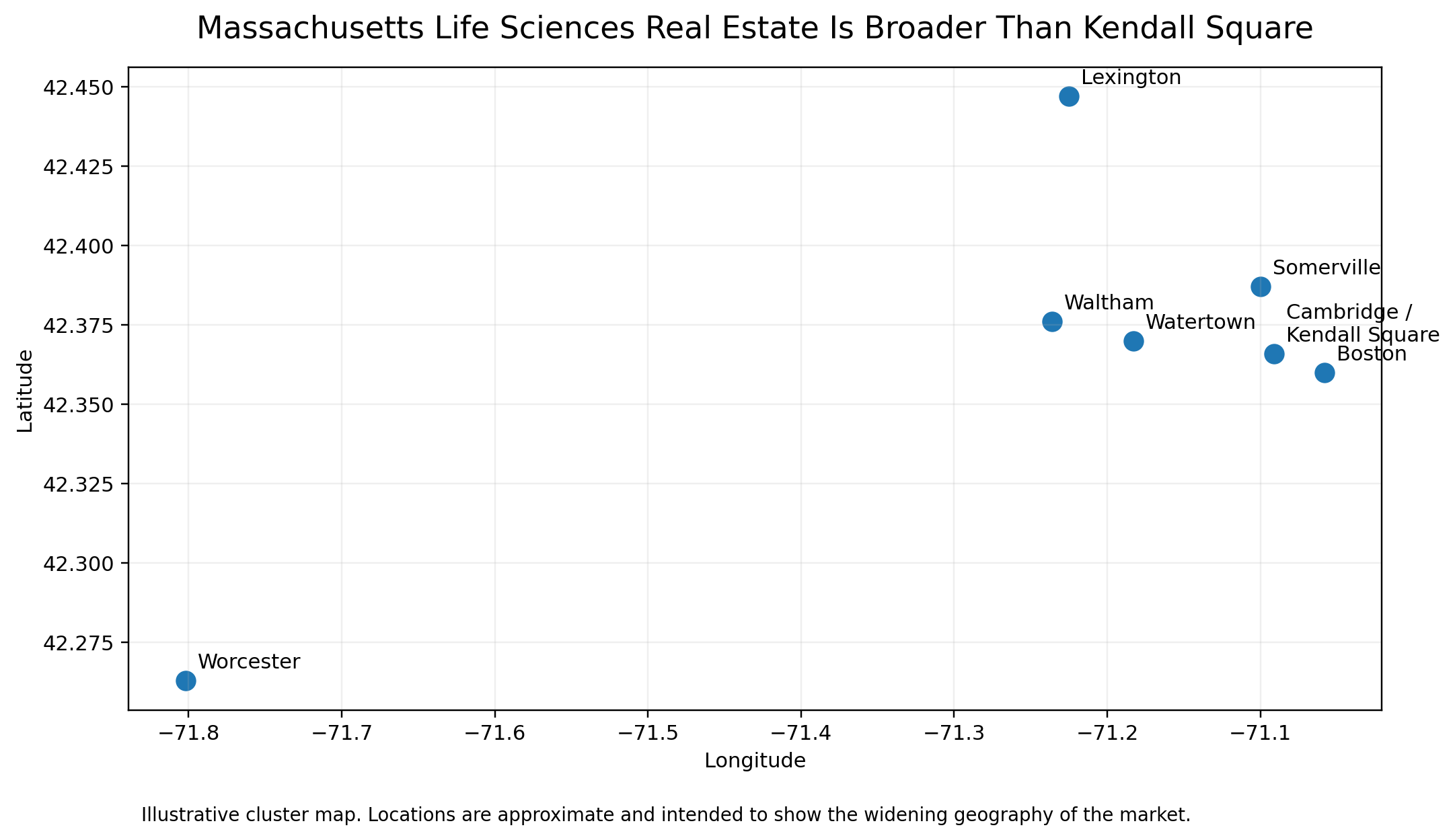
Massachusetts policy reinforces this broader geography. The Mass Leads legislation reauthorized the Massachusetts Life Sciences Initiative for another decade, including $500 million in life sciences investment and an increase in the annual life sciences tax incentive program from $30 million to $40 million. The Massachusetts Life Sciences Center also continues to use incentives to support company expansion and job creation across the Commonwealth.
Real estate therefore becomes part of a larger site-selection calculation. For some companies, proximity to MIT, Harvard, major hospitals and the Cambridge biotechnology network will justify a premium. For others, transportation, infrastructure, workforce access, incentives, expansion capability and occupancy cost may make another Massachusetts location more attractive.
3. The Development Pipeline Is Changing
High vacancy does not necessarily mean that Greater Boston faces an endless stream of new speculative supply. The opposite is beginning to happen. By mid-2026, most life sciences space still under construction was preleased or build-to-suit, while new speculative starts had slowed materially.
That matters because the current oversupply was partly created by projects conceived under very different financing and leasing conditions. With speculative construction sharply reduced, the market has time to absorb existing inventory. Greater Boston also recorded positive life sciences net absorption during the second quarter of 2026 for the first time in approximately two years, with Cambridge contributing significantly to that improvement.
One quarter does not establish a recovery. It does suggest that owners, investors and tenants should distinguish between today’s elevated availability and the amount of competing supply likely to arrive several years from now.
4. Capital Is Returning — But Differently
Real estate demand ultimately follows the companies occupying the buildings. There are reasons for measured optimism. Massachusetts-headquartered biopharma companies raised approximately $3.45 billion in venture capital during the first half of 2026, a 25% year-over-year increase. Eight Massachusetts companies completed IPOs during the first half of the year, equaling the combined total for 2024 and 2025.
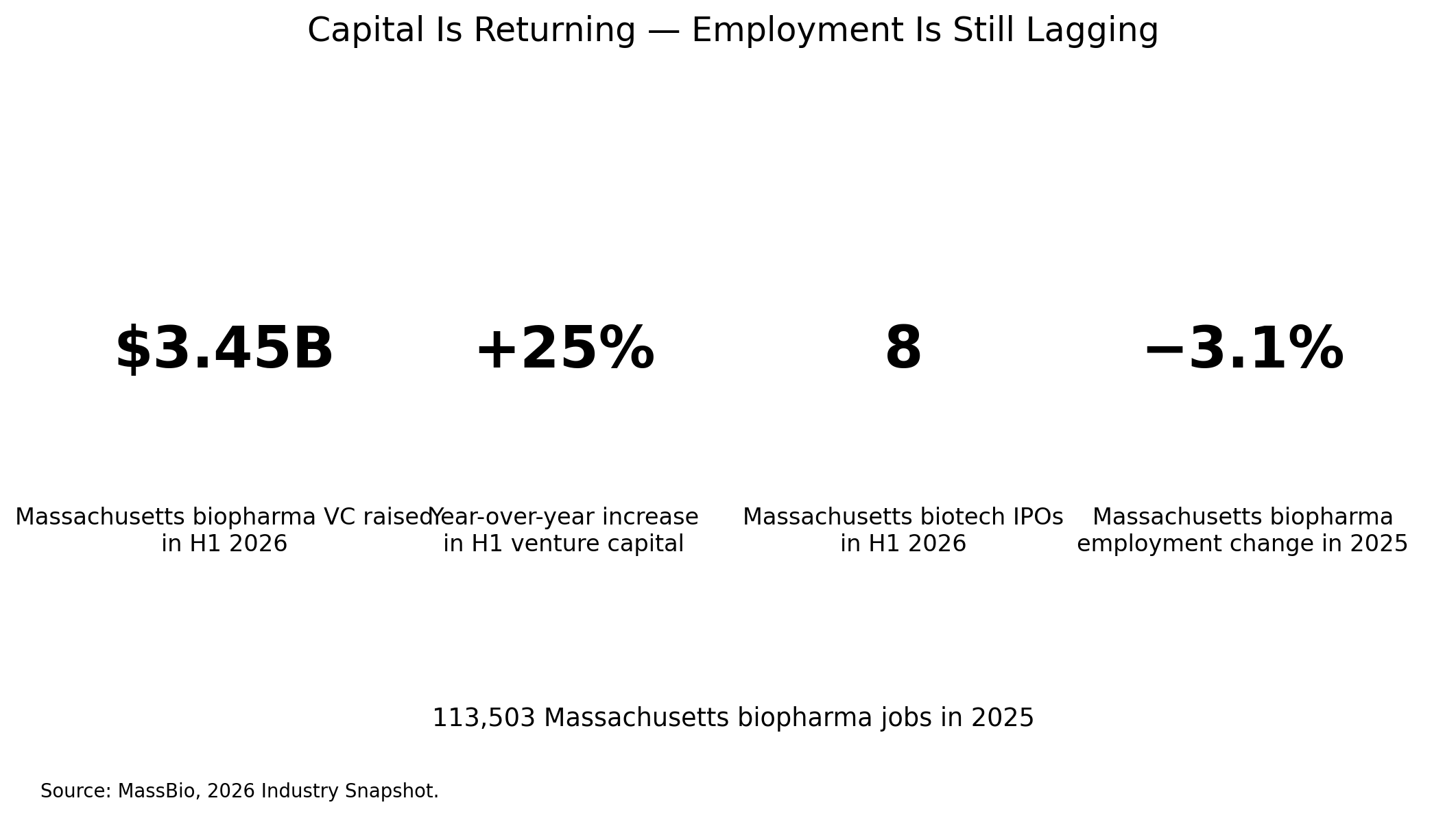
At the same time, Massachusetts biopharma employment declined 3.1% in 2025 to 113,503 jobs, the first annual contraction in more than two decades of tracking by MassBio. Those numbers tell an important story: capital is returning, but companies are likely to remain more disciplined than they were during the prior expansion cycle.
Funding does not automatically translate into immediate large-scale leasing. Companies may prioritize smaller footprints, fitted laboratory space, shorter commitments and expansion options rather than leasing years of anticipated growth in advance. The next life sciences real estate cycle may therefore look materially different from the last one.
5. The Flight to Quality Will Matter
Not every vacant laboratory building is equally positioned to benefit from renewed demand. National market research continues to show tenants gravitating toward newer, higher-quality facilities even while substantial supply remains available.
A laboratory is not merely an office with different finishes. Power capacity, ventilation, floor loading, ceiling heights, backup systems, loading access, hazardous-material handling, vibration control and other building systems can materially affect whether a space works for a particular scientific use.
The result could be an increasingly divided market. Well-located, technically capable buildings that can be occupied with limited additional investment may compete successfully for improving demand. Older or poorly configured laboratory properties may require substantial capital investment, repositioning or consideration of alternative uses.
For investors evaluating discounted or distressed assets, a more useful question than headline price per square foot may be: What will it cost to make this building competitive for its next realistic user?
6. Healthcare Real Estate Adds Another Dimension
The Massachusetts opportunity is broader than biotechnology laboratories. Healthcare delivery continues moving toward outpatient and ambulatory settings, supporting demand for medical office buildings, specialty clinics, ambulatory facilities and other healthcare-oriented real estate.
Massachusetts has an unusually dense network of hospitals, academic medical centers, physician organizations, biotechnology companies and healthcare startups. That creates overlap among traditional medical office space, research facilities, clinical operations, diagnostic uses and emerging healthcare technology companies.
Those uses can raise legal and operational questions that ordinary commercial leases may not adequately address. Permitted-use provisions, zoning, licensing requirements, patient access, assignment rights, exclusivity, hazardous materials, medical waste, equipment installation, data infrastructure, alterations and restoration obligations may all become significant depending on the tenant.
The physical property and the regulatory environment surrounding the occupant cannot always be separated.
7. Real Estate Due Diligence Is Becoming More Important, Not Less
Greater tenant leverage and lower acquisition pricing can make opportunities look compelling. They can also conceal substantial obligations. Before entering a healthcare or life sciences real estate transaction, parties should evaluate:
· zoning and whether the contemplated laboratory, clinical, manufacturing or other specialized use is permitted;
· building systems and whether existing infrastructure can support the intended operation;
· environmental conditions and hazardous-material requirements;
· responsibility for expensive laboratory or medical buildouts;
· ownership and removal of specialized equipment;
· restoration obligations at lease expiration;
· expansion, contraction, assignment and subletting rights;
· regulatory approvals affecting the proposed operation; and
· incentives or economic-development programs that may influence site selection.
Local requirements can be particularly important. Cambridge, for example, regulates development and property uses through its zoning ordinance, with certain proposed uses or developments requiring special permits or other zoning relief. In a fast-moving market, real estate strategy and regulatory strategy should therefore be considered together.
8. The Opportunity in the Reset
Massachusetts did not suddenly lose the ingredients that created one of the world’s leading life sciences ecosystems. The Commonwealth still combines extraordinary research institutions, hospitals, scientific talent, venture capital and established biotechnology and pharmaceutical companies. Massachusetts companies also continue to represent a substantial share of the U.S. drug-development pipeline.
What changed is the real estate market surrounding that ecosystem. A market defined several years ago by scarcity is now defined by choice.
For life sciences and healthcare companies, that creates an opportunity to renegotiate the relationship between facilities and business strategy. For investors and property owners, it places greater importance on asset quality, infrastructure, location and realistic demand. For developers, it argues against assuming that every laboratory project will find a tenant simply because it is located in Greater Boston.
The next phase of Massachusetts healthcare and life sciences real estate will likely reward selectivity rather than speculation. The current correction may ultimately produce a healthier market: one in which companies occupy space because it fits their actual operational needs, capital is deployed more carefully and the strongest properties benefit as the Massachusetts innovation economy works through the excesses of the previous cycle.
Selected Sources
· CBRE, Boston Metro Life Science Figures Q2 2026.
· Colliers, Greater Boston Life Sciences Reports, 2024–2026.
· MassBio, 2026 Industry Snapshot.
· Massachusetts Executive Office of Economic Development, Mass Leads / 2024 Year in Review.
· Massachusetts Life Sciences Center, Tax Incentive Program.
· City of Cambridge, Zoning Ordinance.
· JLL, 2026 U.S. Lab Property Report.
About Lanton, Lanton & Sosa Law PLLC
Lanton, Lanton & Sosa Law advises businesses, investors, healthcare organizations and other clients on legal and regulatory matters affecting commercial real estate, healthcare and life sciences operations. The firm’s work includes commercial transactions, regulatory strategy and government affairs involving organizations operating in Massachusetts and other U.S. markets.
This publication is provided for general informational purposes and does not constitute legal advice.