

Prediction Markets Are Creating a New Risk for Pharmaceutical Vendor Contracts
Prediction markets tied to clinical trials, regulatory decisions, and other pharmaceutical events are creating new questions for vendor contracts and confidentiality provisions. This article looks at what pharmaceutical and life sciences companies may want to review in their agreements and compliance policies.
Prediction markets are creating a new compliance issue for pharmaceutical companies.
Platforms now allow users to trade on events such as regulatory decisions, clinical trial outcomes, and other company specific developments. That creates a simple problem: people outside the company may have access to sensitive information before the market does.
In pharma, that can include CROs, laboratories, consultants, data vendors, clinical partners, and other service providers.
The risk is not limited to disclosure. Someone could use nonpublic information to place a position on an event tied to a clinical trial, FDA decision, regulatory milestone, or commercial development without ever sharing the information with anyone else.
That means companies should review whether their contracts restrict not only disclosure, but also the use of confidential information for prediction markets, event contracts, wagering, or similar financial activity.
What companies should review
Pharmaceutical and life sciences companies may want to look at:
confidentiality provisions
vendor agreements
consulting agreements
clinical services contracts
internal compliance policies
reporting and investigation rights
termination rights tied to misuse of information
The issue is straightforward. Contracts written years ago may not address the ways confidential information can be monetized today.
Clinical and regulatory information can have significant value before it becomes public. As prediction markets grow, legal and compliance teams should make sure their agreements reflect that reality.
Lanton, Lanton & Sosa Law PLLC advises pharmaceutical, healthcare, and life sciences companies on contracts, regulatory issues, vendor relationships, compliance, and commercial risk.
For a deeper discussion, see the recent PharmExec article:
Prediction Markets Expose a Gap in Pharmaceutical Vendor Contracts
https://www.pharmexec.com/view/prediction-markets-expose-gap-pharmaceutical-vendor-contracts

Germany’s Drug-Pricing Investigation: When Trade Pressure Creates More Uncertainty
USTR’s Section 301 investigation into German drug pricing could affect reimbursement, launch timing and investment while placing further strain on U.S.–German trade relations.
The U.S. trade debate over drug pricing is moving into European reimbursement policy. Germany is now one of the clearest examples.
A recent Pink Sheet article by Francesca Bruce examined whether the U.S. Trade Representative’s Section 301 investigation into Germany’s drug-pricing system could produce consequences beyond its stated goal.
This is about more than the price of a single medicine. The investigation could affect how manufacturers plan launches, generate evidence, allocate investment and evaluate the European market.
Germany’s pricing system is part of a larger structure
Germany’s drug-pricing decisions do not occur in a vacuum. Reimbursement is tied to clinical evidence, negotiated assessments, statutory requirements and the role of sickness funds. Those decisions affect how manufacturers estimate revenue and plan commercial activity across Europe.
A U.S. investigation focused on German pricing therefore reaches beyond one national reimbursement system. Manufacturers may delay a launch while they assess whether a pricing decision could trigger additional U.S. scrutiny. They may also reconsider investment in a market where reimbursement policy has become part of a broader trade dispute.
Trade pressure does not automatically improve access
The question is whether pressure on Germany will improve access or make the system harder to navigate.
A company facing greater uncertainty may change launch timing, limit investment or take a more cautious approach to evidence generation. Those decisions can affect medicine availability even when the underlying dispute is about price.
Trade policy also has to account for the differences between the U.S. and European systems. A price that appears low in one market may reflect a different reimbursement structure, purchasing system or approach to clinical value. Treating those differences as evidence of unfair conduct can produce a remedy that does not address the reason prices differ.
The European effect
Germany is one of Europe’s largest pharmaceutical markets. Policy changes there are watched closely by manufacturers, payers and governments throughout the region.
If German reimbursement rules change because of U.S. trade pressure, other European countries may consider whether similar scrutiny could reach their own systems. That uncertainty would not stay in Germany. It could affect negotiations, joint purchasing, launch decisions and investment across Europe.
The risk of a policy misfire
Germany’s pricing system should still be scrutinized. The analysis has to distinguish between a structure that reflects a different health system and conduct that genuinely harms competition or access.
The United States and Germany also have to consider the broader trading relationship. A dispute over pharmaceutical pricing can become part of a larger argument about market access, industrial policy and the treatment of European companies in the U.S. market.
For healthcare executives, this is a market-access issue, not just a trade headline. Its consequences may appear in launch sequencing, reimbursement negotiations, investment planning and patient access before any formal policy change takes effect.
Read Francesca Bruce’s Pink Sheet article, “Could USTR German Pricing Investigation Lead To Policy Misfire And Damaged Trading Relations?”, for the full discussion.
Lanton, Lanton & Sosa Law PLLC advises healthcare and life-sciences companies on legal and policy issues involving pricing, reimbursement, market access and cross-border strategy. Lanton Strategies International provides related policy and market analysis across the United States and Europe.

Massachusetts Healthcare & Life Sciences Real Estate From Scarcity to Selectivity: A Market Reset Creates a New Set of Opportunities
Massachusetts’ life sciences real estate market is changing, creating new opportunities for healthcare and biotech companies evaluating laboratory space, expansion and long-term facilities. This white paper examines how shifting market conditions, lease negotiations, regulatory requirements and capital considerations are reshaping commercial real estate decisions across Greater Boston and Cambridge.
Executive Summary
Massachusetts remains one of the world’s most important healthcare and life sciences markets, but the real estate environment surrounding that ecosystem has changed dramatically. Several years ago, companies competed for laboratory space in Cambridge and Greater Boston. Today, tenants have materially more choice, owners face elevated vacancy and sublease competition, and speculative development has slowed sharply.
The result is not the disappearance of the Massachusetts life sciences market. It is a transition from scarcity to selectivity. Companies can now evaluate space based on economics, flexibility, infrastructure, location and speed to occupancy rather than availability alone. Owners and investors must distinguish between assets that can compete for the next generation of demand and properties that may require substantial repositioning.
This mini-white paper examines the implications of that reset for tenants, developers, owners, investors and healthcare operators considering Massachusetts real estate decisions.
1. The Market Reset: From Scarcity to Tenant Leverage
The speed of the shift is striking. During the expansion cycle, laboratory demand and limited supply encouraged aggressive development, including substantial speculative construction. That pipeline arrived as biotechnology companies began conserving capital, reducing headcount, consolidating operations and returning unwanted space to the market.
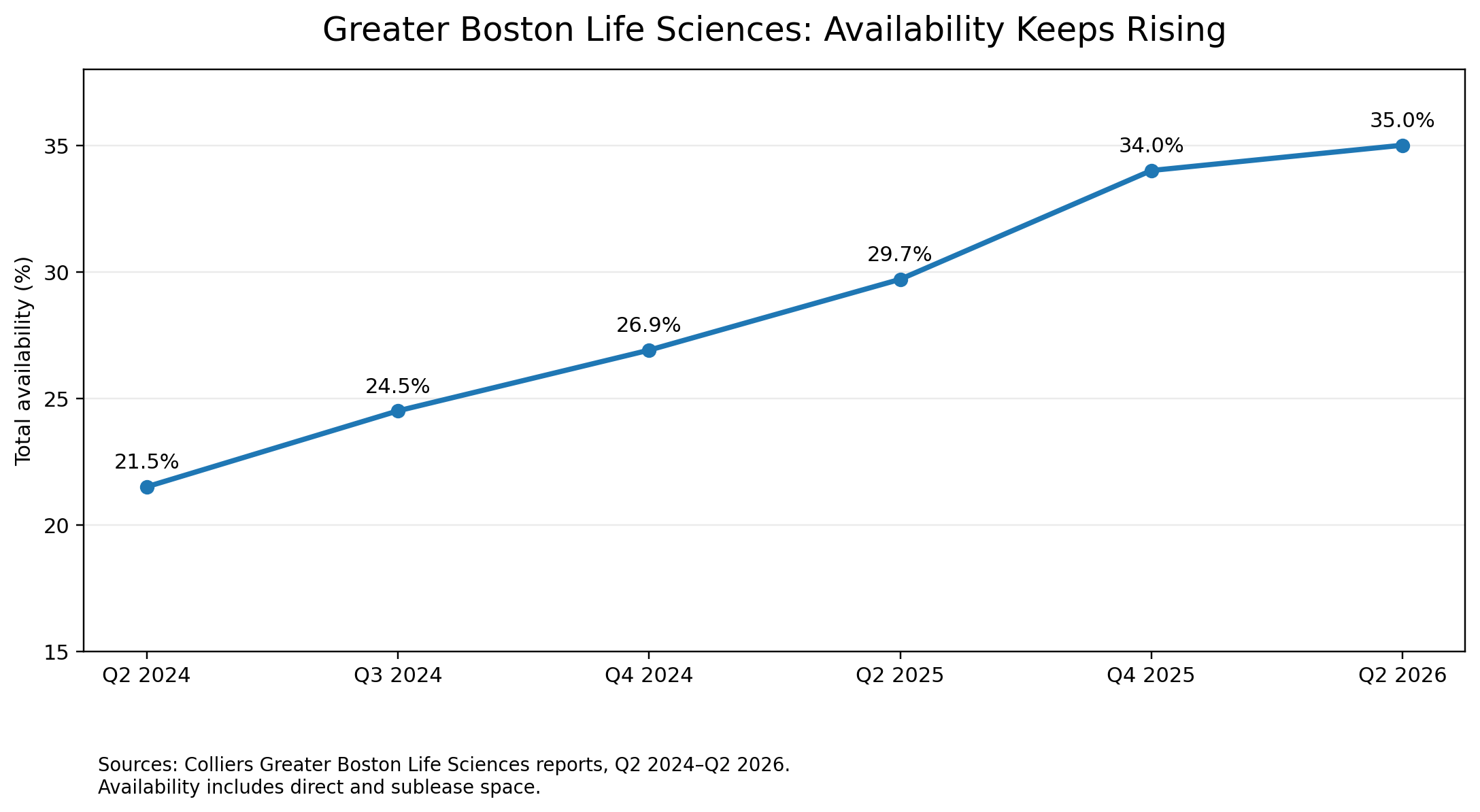
By the second quarter of 2026, total life sciences availability in Greater Boston was roughly 35%, with more than 20 million square feet listed as available. CBRE separately reported a 28.7% vacancy rate and 32.8% availability rate for the Boston metropolitan life sciences market during the same quarter. The precise figures vary by source and methodology, but the direction is unmistakable: Greater Boston moved from a landlord-favored scarcity market to one where tenants have meaningful leverage.
The consequences reach beyond headline vacancy. Prospective tenants can compare multiple high-quality facilities, seek larger concession packages and favor spaces requiring less capital before occupancy. Landlords now compete not only against other buildings but also against sublease inventory and recently completed laboratories that have never been occupied.
For tenants, lease flexibility can become almost as valuable as rental rate. Expansion rights, contraction options, assignment and subletting flexibility, renewal economics, tenant-improvement packages and the ability to avoid overbuilding for projected growth all matter more in a volatile capital environment.
2. Kendall Square Still Matters — But the Market Is Broader
Kendall Square and East Cambridge remain the symbolic and functional center of the Massachusetts biotechnology ecosystem. Geography still matters in a sector where researchers, universities, venture investors, pharmaceutical companies and startups benefit from physical proximity.
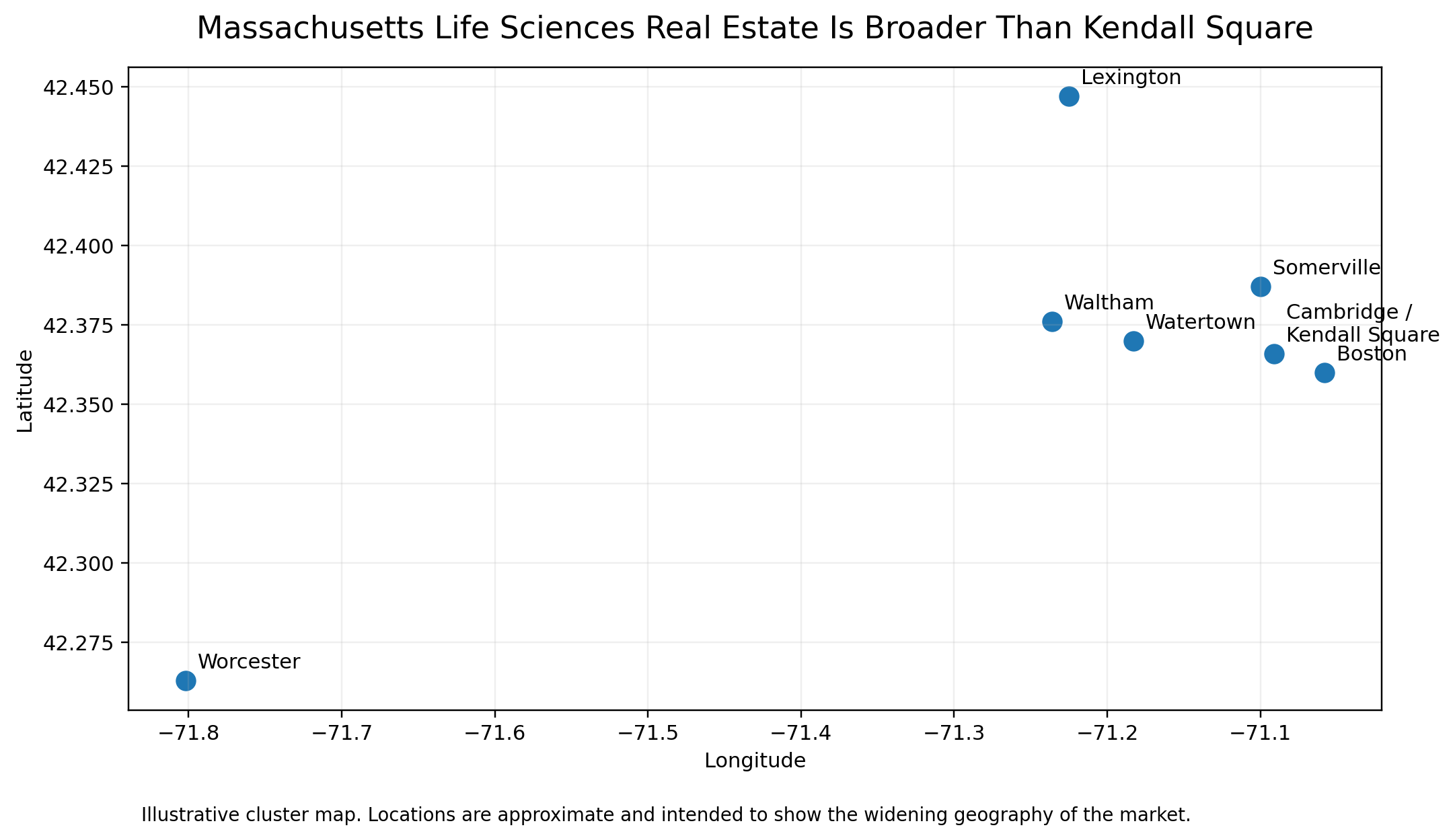
The current market, however, gives companies more ability to ask whether they actually need a Kendall Square address. Greater Boston’s expansion created significant clusters in Boston, Somerville, Watertown, Waltham, Lexington and other communities. Worcester and other Massachusetts markets can also become relevant depending on manufacturing, workforce, cost and incentive considerations.
Massachusetts policy reinforces this broader geography. The Mass Leads legislation reauthorized the Massachusetts Life Sciences Initiative for another decade, including $500 million in life sciences investment and an increase in the annual life sciences tax incentive program from $30 million to $40 million. The Massachusetts Life Sciences Center also continues to use incentives to support company expansion and job creation across the Commonwealth.
Real estate therefore becomes part of a larger site-selection calculation. For some companies, proximity to MIT, Harvard, major hospitals and the Cambridge biotechnology network will justify a premium. For others, transportation, infrastructure, workforce access, incentives, expansion capability and occupancy cost may make another Massachusetts location more attractive.
3. The Development Pipeline Is Changing
High vacancy does not necessarily mean that Greater Boston faces an endless stream of new speculative supply. The opposite is beginning to happen. By mid-2026, most life sciences space still under construction was preleased or build-to-suit, while new speculative starts had slowed materially.
That matters because the current oversupply was partly created by projects conceived under very different financing and leasing conditions. With speculative construction sharply reduced, the market has time to absorb existing inventory. Greater Boston also recorded positive life sciences net absorption during the second quarter of 2026 for the first time in approximately two years, with Cambridge contributing significantly to that improvement.
One quarter does not establish a recovery. It does suggest that owners, investors and tenants should distinguish between today’s elevated availability and the amount of competing supply likely to arrive several years from now.
4. Capital Is Returning — But Differently
Real estate demand ultimately follows the companies occupying the buildings. There are reasons for measured optimism. Massachusetts-headquartered biopharma companies raised approximately $3.45 billion in venture capital during the first half of 2026, a 25% year-over-year increase. Eight Massachusetts companies completed IPOs during the first half of the year, equaling the combined total for 2024 and 2025.
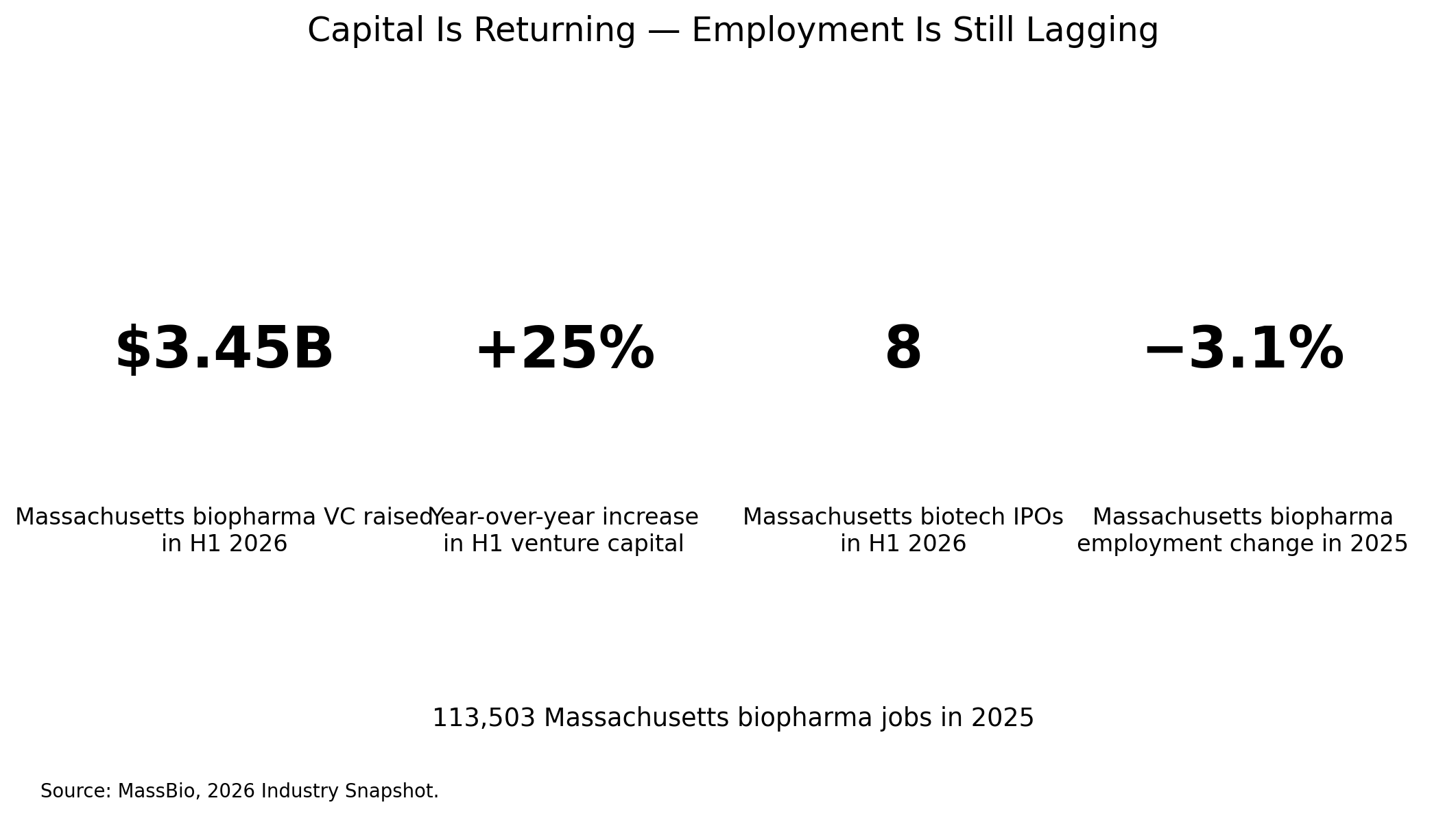
At the same time, Massachusetts biopharma employment declined 3.1% in 2025 to 113,503 jobs, the first annual contraction in more than two decades of tracking by MassBio. Those numbers tell an important story: capital is returning, but companies are likely to remain more disciplined than they were during the prior expansion cycle.
Funding does not automatically translate into immediate large-scale leasing. Companies may prioritize smaller footprints, fitted laboratory space, shorter commitments and expansion options rather than leasing years of anticipated growth in advance. The next life sciences real estate cycle may therefore look materially different from the last one.
5. The Flight to Quality Will Matter
Not every vacant laboratory building is equally positioned to benefit from renewed demand. National market research continues to show tenants gravitating toward newer, higher-quality facilities even while substantial supply remains available.
A laboratory is not merely an office with different finishes. Power capacity, ventilation, floor loading, ceiling heights, backup systems, loading access, hazardous-material handling, vibration control and other building systems can materially affect whether a space works for a particular scientific use.
The result could be an increasingly divided market. Well-located, technically capable buildings that can be occupied with limited additional investment may compete successfully for improving demand. Older or poorly configured laboratory properties may require substantial capital investment, repositioning or consideration of alternative uses.
For investors evaluating discounted or distressed assets, a more useful question than headline price per square foot may be: What will it cost to make this building competitive for its next realistic user?
6. Healthcare Real Estate Adds Another Dimension
The Massachusetts opportunity is broader than biotechnology laboratories. Healthcare delivery continues moving toward outpatient and ambulatory settings, supporting demand for medical office buildings, specialty clinics, ambulatory facilities and other healthcare-oriented real estate.
Massachusetts has an unusually dense network of hospitals, academic medical centers, physician organizations, biotechnology companies and healthcare startups. That creates overlap among traditional medical office space, research facilities, clinical operations, diagnostic uses and emerging healthcare technology companies.
Those uses can raise legal and operational questions that ordinary commercial leases may not adequately address. Permitted-use provisions, zoning, licensing requirements, patient access, assignment rights, exclusivity, hazardous materials, medical waste, equipment installation, data infrastructure, alterations and restoration obligations may all become significant depending on the tenant.
The physical property and the regulatory environment surrounding the occupant cannot always be separated.
7. Real Estate Due Diligence Is Becoming More Important, Not Less
Greater tenant leverage and lower acquisition pricing can make opportunities look compelling. They can also conceal substantial obligations. Before entering a healthcare or life sciences real estate transaction, parties should evaluate:
· zoning and whether the contemplated laboratory, clinical, manufacturing or other specialized use is permitted;
· building systems and whether existing infrastructure can support the intended operation;
· environmental conditions and hazardous-material requirements;
· responsibility for expensive laboratory or medical buildouts;
· ownership and removal of specialized equipment;
· restoration obligations at lease expiration;
· expansion, contraction, assignment and subletting rights;
· regulatory approvals affecting the proposed operation; and
· incentives or economic-development programs that may influence site selection.
Local requirements can be particularly important. Cambridge, for example, regulates development and property uses through its zoning ordinance, with certain proposed uses or developments requiring special permits or other zoning relief. In a fast-moving market, real estate strategy and regulatory strategy should therefore be considered together.
8. The Opportunity in the Reset
Massachusetts did not suddenly lose the ingredients that created one of the world’s leading life sciences ecosystems. The Commonwealth still combines extraordinary research institutions, hospitals, scientific talent, venture capital and established biotechnology and pharmaceutical companies. Massachusetts companies also continue to represent a substantial share of the U.S. drug-development pipeline.
What changed is the real estate market surrounding that ecosystem. A market defined several years ago by scarcity is now defined by choice.
For life sciences and healthcare companies, that creates an opportunity to renegotiate the relationship between facilities and business strategy. For investors and property owners, it places greater importance on asset quality, infrastructure, location and realistic demand. For developers, it argues against assuming that every laboratory project will find a tenant simply because it is located in Greater Boston.
The next phase of Massachusetts healthcare and life sciences real estate will likely reward selectivity rather than speculation. The current correction may ultimately produce a healthier market: one in which companies occupy space because it fits their actual operational needs, capital is deployed more carefully and the strongest properties benefit as the Massachusetts innovation economy works through the excesses of the previous cycle.
Selected Sources
· CBRE, Boston Metro Life Science Figures Q2 2026.
· Colliers, Greater Boston Life Sciences Reports, 2024–2026.
· MassBio, 2026 Industry Snapshot.
· Massachusetts Executive Office of Economic Development, Mass Leads / 2024 Year in Review.
· Massachusetts Life Sciences Center, Tax Incentive Program.
· City of Cambridge, Zoning Ordinance.
· JLL, 2026 U.S. Lab Property Report.
About Lanton, Lanton & Sosa Law PLLC
Lanton, Lanton & Sosa Law advises businesses, investors, healthcare organizations and other clients on legal and regulatory matters affecting commercial real estate, healthcare and life sciences operations. The firm’s work includes commercial transactions, regulatory strategy and government affairs involving organizations operating in Massachusetts and other U.S. markets.
This publication is provided for general informational purposes and does not constitute legal advice.

What Rutledge Still Means for PBM Regulation
What Rutledge and Mulready mean for PBM regulation, pharmacy reimbursement, 340B, network design, contracts and federal oversight.
Pharmacy benefit managers are facing renewed scrutiny from state legislatures, Congress and federal agencies. The central legal issue is not whether PBMs can be regulated. It is which kinds of regulation can survive federal preemption rules.
Our new analysis in Pharmaceutical Executive, “The Legacy of Rutledge: What States and Congress Can Still Regulate Pharmacy Benefit Managers,” examines how the legal framework is developing.
Lanton, Lanton & Sosa Law PLLC advises pharmacies, healthcare organizations, employers and regulated businesses on PBM contracts, reimbursement, pharmacy regulation, 340B, government affairs, compliance and healthcare transactions.
The short version
In Rutledge v. Pharmaceutical Care Management Association, the Supreme Court upheld an Arkansas law requiring PBMs to reimburse pharmacies at or above certain acquisition-cost levels and provide an appeals process.
The Court treated the law as regulation of pharmacy costs. It did not view the statute as directing the design or administration of an ERISA health plan.
The Tenth Circuit’s decision in Pharmaceutical Care Management Association v. Mulready identified a different boundary. Provisions affecting pharmacy networks and preferred-network participation may face preemption when they begin to control how an ERISA plan or Medicare Part D benefit is structured and administered.
The two decisions should be read together:
States retain room to regulate reimbursement, payment practices, MAC lists, dispensing fees and appeals.
States face greater risk when laws dictate network design, benefit structure or plan administration.
Congress can address areas that may be difficult for states to regulate, including PBM compensation, fiduciary duties, ownership, kickbacks, audit rights and pharmacy access.
Why this matters to pharmacy executives
The legal analysis is connected to daily operations. A pharmacy should know what it was paid at the point of sale, what fees were later imposed, how the final reimbursement was calculated and whether the contract provides a meaningful appeal or audit process.
Specialty pharmacies should review whether retail-oriented performance measures accurately reflect complex dispensing, patient-support and clinical services.
Covered entities and contract pharmacies should also examine 340B documentation, manufacturer restrictions, duplicate-discount controls, inventory procedures and audit records.
Employers and plan sponsors should identify direct and indirect PBM compensation, affiliated arrangements, spread pricing, formulary incentives and the practical value of their audit rights.
What to review now
A focused review should cover:
PBM reimbursement and reconciliation data.
MAC-list and appeal procedures.
Contract terms governing audits, fees and termination.
Network and specialty-pharmacy provisions.
340B contract-pharmacy and documentation practices.
The effect of new federal reporting and fiduciary requirements.
The policy debate will continue through legislation, litigation, agency action and contract negotiations. The organizations best prepared for the next phase will be the ones that understand their contracts, payment data and operational records before a dispute begins.
Read the full analysis in Pharmaceutical Executive: The Legacy of Rutledge: What States and Congress Can Still Regulate Pharmacy Benefit Managers.
This article is for general informational purposes only and does not constitute legal advice.

The Legal Questions Behind a Pharmaceutical Manufacturing Move
A pharmaceutical manufacturing move involves real estate, FDA compliance, incentives, trade rules, contracts and long-term operational risk.
A pharmaceutical company considering a new U.S. manufacturing site is not making a single decision. It is taking on a series of legal, regulatory and commercial questions at the same time.
Ipsen is reportedly evaluating whether to establish a U.S. manufacturing facility while continuing to invest in its U.K. operations. No final decision has been announced. Still, the issue illustrates what companies must examine when production strategy begins to shift. The Wall Street Journal, September 11, 2026
The first question is whether the company should build, acquire, expand an existing facility or use a contract manufacturer. Each path creates different obligations involving financing, real estate, construction, environmental review, licensing, employment and supply agreements.
The regulatory analysis is just as important. A facility may need to meet FDA requirements, address changes to manufacturing processes and maintain compliance during a transition. Moving production from one country to another can also affect inspections, documentation, release procedures and responsibilities between related companies and outside vendors.
Government incentives add another layer. Tax credits, grants and other programs may make a U.S. project more attractive, but they often come with eligibility rules, reporting requirements, employment commitments or limits on how funds may be used.
Trade policy also matters. Tariffs, country-of-origin rules and future changes in U.S. policy can affect the economics of a facility long after the initial investment decision has been made.
The legal work should begin before a company chooses a site. By then, the company should understand the regulatory pathway, the incentives it may qualify for, the contractual structure it needs and the risks of changing production later.
Manufacturing strategy is now part of the broader business strategy. Companies that treat it as only a real-estate or operations project may miss the legal and commercial consequences.
At Lanton, Lanton & Sosa Law PLLC, we help healthcare and life-sciences companies think through the legal, regulatory and government-affairs issues that arise when manufacturing, investment and market strategy begin to overlap. The earlier those questions are addressed, the more options a company usually has.
This article is for general educational purposes only and does not constitute legal advice. Specific manufacturing, regulatory, incentive and transactional questions should be reviewed with qualified counsel.

Health Law Questions Healthcare Leaders Are Facing Now
A preview of the Massachusetts Bar Association Health Law Section’s October 8 conference, where Ron Lanton will join other speakers to discuss PBM reform, reimbursement, medical autonomy, reproductive justice, and artificial intelligence in healthcare.
The Massachusetts Bar Association’s Health Law Section will hold its annual conference on Thursday, October 8, from 12:30 to 5:30 p.m. I’ll be participating as one of the speakers, with the discussion focused on the legal and practical issues healthcare organizations are facing now.
The program will cover PBM reform, reproductive justice, medical autonomy, reimbursement, and artificial intelligence in healthcare.
They may be listed as separate topics, but healthcare organizations often have to deal with them at the same time.
A reimbursement rule can affect whether a patient receives care. PBM policies can change how pharmacies and providers operate. New technology can raise questions about privacy, responsibility, reimbursement, and professional judgment. Political and regulatory decisions can affect how organizations plan and invest.
The common thread is practical risk. Healthcare leaders have to understand not only what a rule says, but how it will affect operations, patient care, employees, and business decisions.
Artificial intelligence makes that challenge more immediate. Healthcare organizations are adopting tools for research, administration, diagnosis, and communication, often before the legal and regulatory expectations are fully settled. That makes oversight, documentation, privacy, and accountability important questions to address early.
The conference will bring together healthcare attorneys and other professionals to discuss these issues in a practical setting. I’m looking forward to joining the other speakers and contributing to the conversation.
The event will be held in person at the Massachusetts Bar Association. Registration is available through the Massachusetts Bar Association’s Health Law Section.
This article is for general educational purposes only and does not constitute legal advice. Healthcare law depends on the specific facts and applicable law. Organizations should consult qualified counsel regarding their circumstances.

U.S. Most-Favored-Nation Drug Pricing Raises Questions Beyond the Price of Medicines
U.S. most-favored-nation drug pricing could affect far more than what Americans pay for medicines. Ron Lanton examines the potential impact on pharmaceutical launch sequencing, existing products, antitrust considerations and international markets, including Switzerland, following recent coverage by APM Market Access.
The renewed focus on most-favored-nation drug pricing in the United States is often discussed as a straightforward question of whether the government can bring American drug prices closer to those paid in other countries. The consequences could be much broader.
I recently spoke with Jen Brogan of APM Market Access about several of those issues, including how pharmaceutical manufacturers may approach future drug launches, what happens when pricing decisions in one country begin affecting another market, and whether countries outside the United States could face additional pressure as the policy develops.
One of the biggest questions is launch sequencing. Pharmaceutical companies do not make launch decisions one country at a time without considering what happens elsewhere. If a lower price negotiated in one market can eventually influence the price available in the United States, companies may have to reconsider where and when certain products are introduced. The answer may also differ considerably depending on the drug, its patient population, available alternatives and the economics surrounding the product.
APM Market Access examined that issue in “U.S. MFN could shift pharma launch sequencing ‘per class of drug’ – legal expert”.
The policy may also affect products already on the market differently from new medicines. Existing products already have established pricing, reimbursement arrangements and commercial expectations across multiple countries. That can make changing the economics surrounding those products particularly complicated.
APM addressed that question in “MFN could put greater short-term pressure on existing drugs than new launches – pricing expert”.
There is also a legal issue that deserves attention. International reference pricing can create situations where pricing information or arrangements in one market begin influencing decisions in another. That does not automatically create an antitrust problem. It does mean companies need to pay close attention to how pricing information is obtained, communicated and used when commercial decisions are being made across markets.
That issue was discussed in “U.S. MFN policy raises potential ‘antitrust’ questions over cross-market drug pricing, says legal expert”.
Finally, this is not only a U.S. policy discussion. Countries with significant pharmaceutical industries and comparatively lower medicine prices may find themselves part of the debate.
Switzerland is a particularly interesting example. It is home to some of the world's largest pharmaceutical companies, while the country is also dealing with its own questions about pharmaceutical competitiveness, research investment and the economics of maintaining a strong life sciences sector. If the United States places greater importance on international price comparisons, Switzerland and other European markets could face difficult choices between controlling domestic healthcare spending and maintaining an environment that attracts pharmaceutical investment.
APM explored that issue in “Switzerland could become target of U.S. pressure on drug pricing, says legal expert”.
Taken together, these questions illustrate why MFN cannot be evaluated solely by looking at the price of a prescription today. Drug pricing policy can affect launch decisions, investment, competition, reimbursement and the relationship between pharmaceutical markets around the world.
For pharmaceutical manufacturers, healthcare organizations, policymakers and investors, the important question will be how those consequences develop as the policy moves from announcement to implementation.
APM Market Access Coverage
U.S. MFN could shift pharma launch sequencing ‘per class of drug’ – legal expert
APM Market Access
MFN could put greater short-term pressure on existing drugs than new launches – pricing expert
APM Market Access
U.S. MFN policy raises potential ‘antitrust’ questions over cross-market drug pricing, says legal expert
APM Market Access
Switzerland could become target of U.S. pressure on drug pricing, says legal expert
APM Market Access
The APM Market Access articles are available through APM Market Access and may require a subscription.

Boston's Life Sciences Real Estate Market Has Changed: What Property Owners Should Do Next
Boston’s life sciences real estate market has shifted, creating new leasing, financing, redevelopment, and acquisition decisions for property owners and investors. Maria Sosa explains how early legal planning can help owners evaluate lease restructurings, adaptive reuse, refinancing, construction obligations, and distressed-asset opportunities while protecting long-term property value.
Boston's life sciences market has long been one of the strongest commercial real estate sectors in the country. For years, biotechnology companies, pharmaceutical manufacturers, research institutions, and investors fueled an unprecedented demand for laboratory and research facilities throughout Greater Boston and Cambridge.
Today, however, the market looks very different.
Higher interest rates, slowing venture capital investment, and the delivery of millions of square feet of new laboratory space have created increased vacancy rates and new financial pressures for property owners and developers. While these market conditions present challenges, they also create opportunities for owners who make informed legal and business decisions.
Whether you own a laboratory building, are developing a life sciences project, or are evaluating an acquisition, understanding the legal implications of today's market is essential.
Why Has the Market Changed?
For nearly a decade, Boston's life sciences industry experienced remarkable growth. Developers responded by constructing new laboratory and research facilities to meet increasing demand.
As market conditions shifted, however, several factors converged:
Venture capital funding slowed.
Interest rates increased.
Some biotechnology companies delayed expansion plans.
Demand for laboratory space softened.
New construction continued entering the market.
The result has been increased vacancy in several life sciences submarkets and greater competition among landlords for qualified tenants.
Although demand for life sciences space has moderated, Boston remains one of the world's leading biotechnology markets. The current environment requires a more strategic approach to ownership, leasing, financing, and development.
What Does This Mean for Property Owners?
Owners are facing decisions that would have been unlikely only a few years ago.
Common questions include:
Should existing laboratory space be repositioned?
Is it time to renegotiate leases?
Should construction projects continue as planned?
Are financing terms still sustainable?
Does it make sense to sell or recapitalize assets?
Can a property be converted to another use?
Each decision carries legal, financial, and operational consequences that should be evaluated together rather than independently.
Evaluating Existing Leases
Commercial leases often become the first area requiring attention during changing market conditions.
Owners may experience:
Requests for rent concessions.
Tenant downsizing.
Expansion delays.
Early termination requests.
Sublease proposals.
Assignment requests.
Rather than viewing these requests solely as disputes, landlords may benefit from evaluating whether negotiated solutions better protect the long-term value of the property.
Lease amendments, rent restructuring, revised tenant improvement obligations, and carefully drafted extensions can preserve occupancy while reducing litigation risk.
Every proposed modification should be reviewed carefully to ensure it aligns with the owner's broader investment strategy.
Is Adaptive Reuse the Right Strategy?
One of the most significant trends emerging from today's market is adaptive reuse.
Some owners are evaluating whether highly specialized laboratory properties should be converted into alternative uses, including:
Traditional office space.
Medical office buildings.
Residential developments.
Mixed-use projects.
Flex industrial facilities.
These projects often require extensive legal planning before any physical work begins.
Owners should carefully evaluate:
Local zoning requirements.
Municipal permitting.
Existing lease obligations.
Environmental regulations.
Building code compliance.
Financing restrictions.
Title and easement issues.
Early legal planning can help identify obstacles before significant resources are committed to redevelopment.
Construction Projects May Require Reassessment
Projects initiated during stronger market conditions may now face different economic realities.
Developers should review:
Construction contracts.
Financing agreements.
Completion deadlines.
Contractor obligations.
Change order procedures.
Delay provisions.
Insurance requirements.
Revisiting these agreements early may provide opportunities to reduce risk, negotiate modifications, or preserve flexibility as market conditions continue to evolve.
Financing Should Not Be Overlooked
Commercial financing deserves close attention in today's environment.
As loans mature, owners may encounter:
Higher refinancing costs.
Lower property valuations.
Increased lender scrutiny.
Reduced loan proceeds.
Waiting until a loan default occurs often limits available options.
Property owners should consider discussing potential restructuring strategies with legal counsel before financial challenges become more difficult to resolve.
New Opportunities for Investors
Periods of market adjustment frequently create attractive acquisition opportunities.
Investors evaluating distressed or underperforming assets should conduct comprehensive legal due diligence before closing.
Important areas of review include:
Existing leases.
Environmental reports.
Title matters.
Pending litigation.
Municipal compliance.
Development approvals.
Financing obligations.
Construction contracts.
Proper due diligence helps investors understand both the opportunities and the risks associated with complex commercial acquisitions.
Why Experienced Legal Counsel Matters
Commercial real estate transactions rarely involve a single legal issue.
A lease amendment may affect financing.
A financing modification may influence redevelopment plans.
A zoning issue may delay construction.
A construction dispute may impact investor relationships.
Understanding how these issues interact allows owners and investors to make more informed business decisions while reducing unnecessary legal exposure.
Experienced counsel can help coordinate these moving parts, negotiate practical solutions, and position projects for long-term success.
Looking Ahead
Boston's life sciences sector remains one of the country's most innovative and resilient industries. Although the market is experiencing a period of adjustment, organizations that proactively evaluate their legal and business strategies will often be better positioned to capitalize on future opportunities.
Whether the next step involves renegotiating leases, restructuring financing, acquiring distressed assets, or exploring redevelopment options, early planning can significantly reduce risk and preserve long-term value.
How Lanton Law Assists Commercial Real Estate Clients
Lanton Law represents commercial property owners, developers, investors, landlords, tenants, healthcare organizations, and businesses throughout Massachusetts in a wide range of commercial real estate matters.
Our attorneys regularly advise clients on:
Commercial leasing and lease negotiations.
Property acquisitions and dispositions.
Purchase and Sale Agreements.
Due diligence investigations.
Commercial financing transactions.
Construction and development contracts.
Land use and zoning matters.
Joint ventures and business structuring.
Commercial real estate disputes.
Every commercial real estate matter presents unique legal and business considerations. We work closely with our clients to identify practical solutions that protect their investments while supporting their long-term business objectives.
If you own, lease, develop, or invest in commercial real estate in Massachusetts, our team is available to discuss your project and help you navigate today's evolving market with confidence.

New York State Bar Association (NYSBA) Journal Publishes Ron Lanton III Article on Global Healthcare Reform and Life Sciences Strategy
Ron Lanton III’s article, “The Global Healthcare Divorce: How US and EU Reforms Are Reshaping the Structure of Life Sciences Companies,” was published in the Summer 2026 issue of the New York State Bar Association Journal. The article examines how healthcare reform in the United States and European Union is affecting life sciences strategy, market access, reimbursement planning, and company structure.
Lanton, Lanton & Sosa Law PLLC is pleased to share that Ron Lanton III’s article, “The Global Healthcare Divorce: How US and EU Reforms Are Reshaping the Structure of Life Sciences Companies,” was published in the Summer 2026 issue of the New York State Bar Association Journal.
The article examines how healthcare reform in the United States and European Union is beginning to affect more than compliance. These changes are also shaping life sciences strategy, company structure, market access, exclusivity, reimbursement planning, and capital decisions.
For healthcare and life sciences companies, the larger takeaway is that regulatory change is becoming a business planning issue. Companies operating across markets need to understand how policy developments may affect contracts, commercialization strategy, investor expectations, and long-term growth.
At Lanton, Lanton & Sosa Law PLLC, we work with healthcare organizations, life sciences companies, pharmacies, physician groups, and health-adjacent businesses on the legal, regulatory, and strategic issues that affect growth in highly regulated markets.
The article begins on page 51 of the Summer 2026 NYSBA Journal seen at https://nysba.org/wp-content/uploads/2026/06/jrnl_summer2026-6-23-26-FINAL-WEB.pdf

In Pharmaceutical Executive: Ron Lanton on the FDA’s Changing Clinical Trial Framework
Ron Lanton discusses the FDA’s evolving approach to clinical trial evidence and what the agency’s shift away from the traditional two-trial expectation could mean for drug development.
he FDA recently signaled a shift away from the long-standing expectation that new drugs demonstrate effectiveness through two pivotal trials.
The agency’s updated approach to clinical trial evidence could have implications for sponsors navigating regulatory approval pathways.
In this brief update, Ron Lanton walks through what the FDA announced and how the agency is thinking about trial requirements moving forward.
@Pharmaceutical Executive
https://www.pharmexec.com/shorts/fda-drops-two-trial-rule-new-drugs