
COINS and Biotech: The Deal Structure May Matter More Than the License
Treasury’s proposed COINS rules may leave traditional pharma licensing outside core restrictions while creating new questions for equity, joint-venture and NewCo deals.
For pharmaceutical and biotechnology companies working across borders, the Treasury Department’s proposed COINS rules make the structure of a transaction more important than the label attached to it.
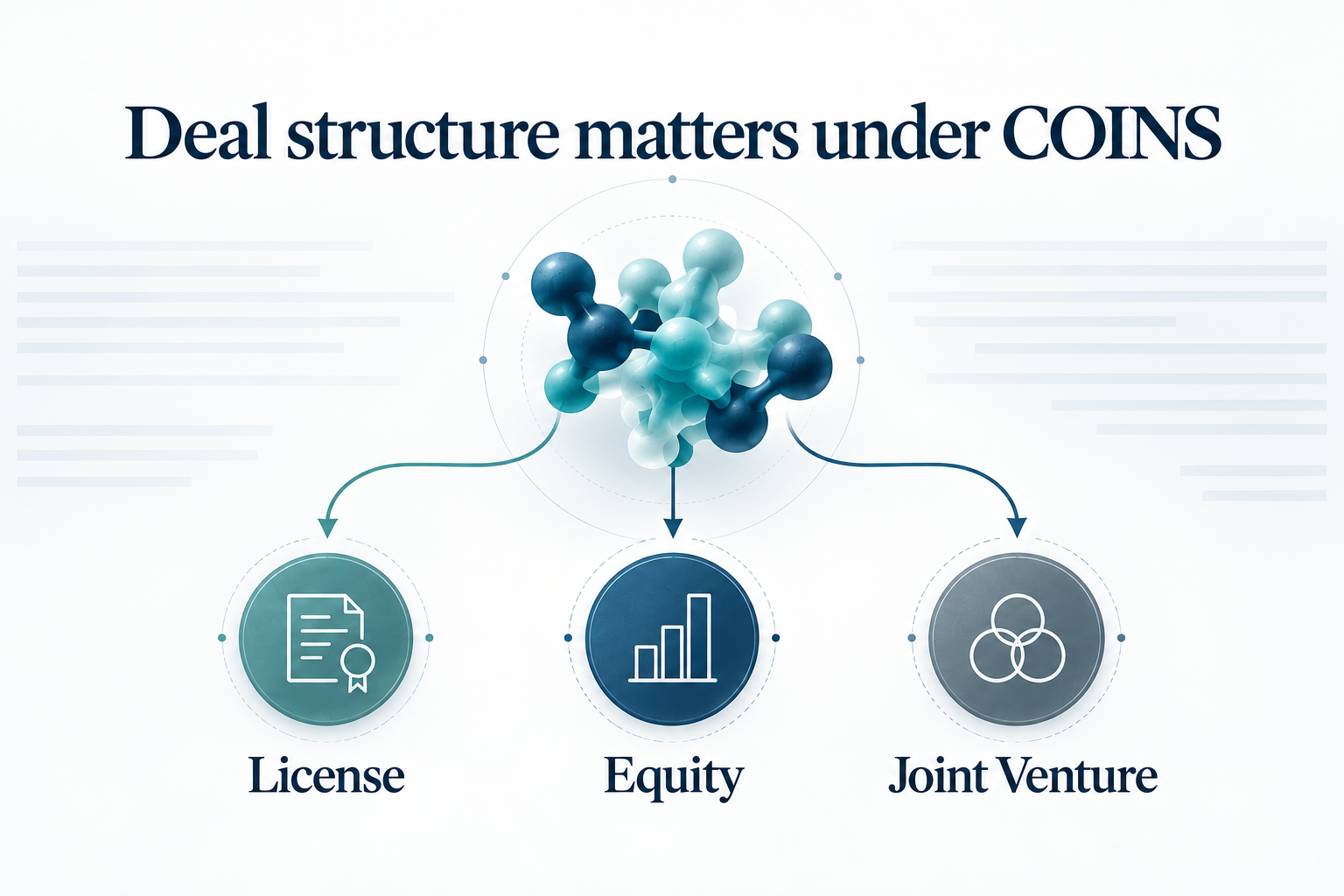
A traditional license may be treated very differently from a transaction that includes equity, convertible financing, shared development costs, profit-sharing or a joint venture.
That difference may determine which regulatory regime applies and whether the parties need to change the structure before closing.
The Treasury Department’s proposed rule would implement the Comprehensive Outbound Investment National Security Act, or COINS Act. It would prohibit certain transactions and require notification for others when U.S. persons engage in covered transactions involving foreign persons in sensitive technology sectors. Written comments are due December 7, 2026. Treasury’s proposed rule
Traditional licensing is lower risk, not a safe harbor
A conventional licensing arrangement in which a pharmaceutical company pays an upfront fee, development milestones and royalties for rights outside China is materially different from an equity investment or joint venture.
That does not create a categorical safe harbor. The proposed rule includes an anti-evasion provision, and the outcome may depend on the full economic and governance structure of the transaction.
Milestone payments and royalties, standing alone, do not necessarily create an equity interest. The analysis becomes less clear when a deal includes an option to acquire equity, conversion rights, board or governance rights, control over a new company, financing obligations or other features that give one party an ownership-like position.
Companies should treat a plain license as a lower-risk starting point, not as an automatic exclusion from review.
The harder questions arise when a license includes other rights
Examples include:
A U.S. company taking an equity interest in a Chinese biotech.
A Chinese licensor receiving equity in a newly formed U.S. company.
Convertible debt that includes equity rights or other covered features.
A collaboration in which both parties contribute capital or assets and share profits or losses.
A joint venture involving shared development costs, governance or ownership rights.
A fund or limited-partner investment connected to a covered foreign person.
These structures are common in biotech because they let companies share development costs, manage risk and retain upside. They are also the structures most likely to require closer review.
COINS and CFIUS address different directions of investment
A Chinese licensor taking equity in a U.S. NewCo is principally an inbound-investment question. Depending on the NewCo’s technology, data and governance arrangements, the transaction could raise issues under CFIUS, particularly if the company handles sensitive personal data or operates in a critical-technology area.
COINS addresses a different direction of investment. It generally concerns a U.S. person providing capital or another covered investment to a covered foreign person in a country of concern. That could include a U.S. company investing directly in a Chinese biotech, funding a China-based development vehicle or participating in another covered foreign transaction.
A NewCo may involve both regimes, but the analysis is not the same. CFIUS examines foreign investment into the United States. COINS examines covered outbound investment from the United States.
The proposed rule does not provide a complete answer for every NewCo structure. If a Chinese licensor receives a minority stake in a U.S. NewCo, that stake is not automatically the same as a U.S. person acquiring equity in a Chinese company. But the arrangement could still draw scrutiny if Treasury views the structure as an effort to avoid restrictions that would apply to a more direct investment.
The arrangement may also raise a joint-venture question if the parties contribute capital or assets and share development costs, profits or losses.
Ownership percentage is not the only issue
The analysis is not limited to the percentage of equity owned. Governance and operational rights may also matter.
Board seats, observer rights, access to management, technical assistance, strategic input and other forms of support can provide benefits beyond the cash investment. Convertible notes and minority equity interests may require review when they are combined with those rights.
Those facts do not automatically make a transaction prohibited or notifiable. They should be reviewed alongside the equity terms, financing, control arrangements, technology transfer and the identity of the parties.
The knowledge standard and anti-evasion risk
Treasury’s knowledge standard also matters. A company may not avoid responsibility simply by declining to ask obvious questions.
The proposed framework looks at actual knowledge and whether the party knew, or reasonably should have known, relevant facts after a reasonable and diligent inquiry. That makes diligence important where a transaction includes side letters, stepped options, offshore entities, convertible rights or other arrangements that separate the economic substance of a deal from its formal documents.
Companies should not assume that a transaction is outside the rule merely because the equity, financing or control rights are placed in a separate agreement or entity.
Why the December 7 deadline matters
The comment period gives companies and industry groups an opportunity to explain how biotechnology transactions actually work.
Comments could address:
The difference between a traditional license and an investment.
How milestone payments, royalties and option rights should be treated.
Whether ordinary research-and-development collaborations should be distinguished from joint ventures.
How NewCo structures should be evaluated when the foreign licensor receives a minority interest.
Whether the definition of “pharmaceutical compounds” is too broad.
How the rule could affect patient access, clinical development and U.S. biotechnology competitiveness.
What guidance companies need before entering into complex cross-border transactions.
Treasury has requested empirical information and concrete examples. A detailed explanation of how a provision would affect an actual deal structure, development program or investment decision may be more useful than a general objection.
What companies should do now
Companies considering a China-related transaction should ask five questions before finalizing the term sheet:
Is this a license, an investment, a joint venture or a combination of those structures?
Does either party receive equity, convertible rights, governance rights or control?
Are both parties contributing capital, assets or development costs?
Could a U.S. subsidiary, U.S. person or U.S.-controlled fund be involved?
Should the company submit comments before December 7?
The proposed COINS rules do not make every cross-border pharmaceutical transaction impossible. They make transaction design more important.
Early review gives the parties room to separate a license from an equity investment, reconsider a joint-venture structure, assess possible CFIUS implications, obtain a clearer regulatory analysis or explain their concerns directly to Treasury during the comment period.
Lanton, Lanton & Sosa Law advises healthcare and life-sciences companies on cross-border legal and regulatory issues. Lanton Strategies International supports clients with policy, government-affairs and international strategy.
Companies evaluating a proposed transaction or considering comments to Treasury should review the structure while the parties can still revise it.